
Smart Home Security Installation Cost and Resale Value
Smart home security system installation cost and resale value explained, with real numbers on equipment, labor, and ROI. Call 8333658755 for contractor help.

By Zoe Harper
Learn more about Home Security and Alarms Install for guides, costs, and what to expect.
Compare Home Security and Alarms Install Pros Near You

Enter your ZIP code to compare top-rated local professionals and request free quotes.
You are standing in the smart home aisle, staring at a box that promises peace of mind, and wondering if the numbers actually work in your favor. A smart home security system installation cost and resale value calculation is not as simple as picking a kit off the shelf. It involves upfront equipment prices, professional labor rates, monthly monitoring fees, and the unpredictable ways buyers appraise technology when you sell. Get the math wrong and you either overspend on gadgets that do not impress anyone or underinvest in a system that could have commanded a higher offer. This guide breaks down every dollar and every percentage point so you can decide with confidence.
What Drives Smart Home Security System Installation Cost
The installation cost of a smart home security system depends on three primary buckets: equipment, labor, and ongoing service. Equipment alone can range from $200 for a basic DIY kit with a few door sensors and a hub to more than $2,500 for a comprehensive setup with outdoor cameras, glass break detectors, smart locks, and a video doorbell. Labor is the wild card. A simple wireless system that mounts with adhesive strips might take a handy homeowner two hours to set up. A hardwired system with multiple camera runs and a central panel can require an electrician and a low-voltage technician for a full day or more.Geographic location also moves the needle. In high-cost metro areas like San Francisco or New York, licensed electricians charge $100 to $150 per hour. In smaller markets across the Midwest and South, the same work might cost $60 to $90 per hour. If you are planning a broader renovation alongside your security upgrade, our guide on cabinet installation cost and pro tips explains how to sequence trades so you are not paying multiple mobilization fees.
DIY Versus Professional Installation: A Real Cost Comparison
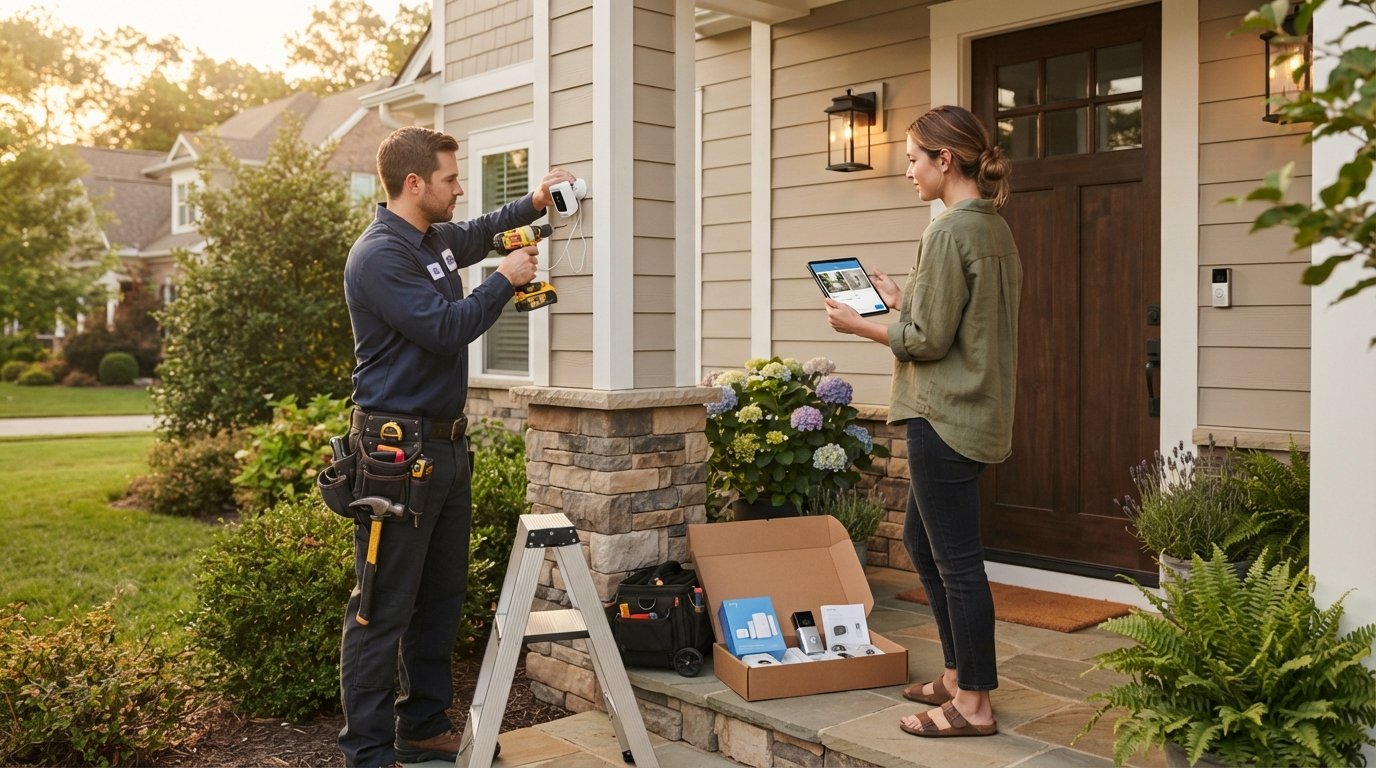
DIY installation saves money on labor but costs time and carries risk. A wireless system from a major brand can be self-installed in an afternoon, and you avoid the $300 to $800 professional fee entirely. However, DIY systems often have limitations: fewer hardwired sensors, less reliable cellular backup, and no professional monitoring unless you add a subscription. Professional installation, by contrast, ensures proper placement for motion detection, secure mounting for outdoor cameras, and integration with existing doorbells and locks.Here is a quick breakdown of typical costs for a three-bedroom home with four entry points, two outdoor cameras, and a video doorbell:
- DIY wireless kit: $400 to $700 for equipment, $0 labor, $10 to $25 per month monitoring.
- Professional wireless install: $600 to $1,200 for equipment, $300 to $500 labor, $25 to $45 per month monitoring.
- Hardwired professional system: $1,200 to $2,500 for equipment, $600 to $1,200 labor, $40 to $60 per month monitoring.
The hardwired system costs more upfront but tends to last longer and adds more resale value because buyers perceive it as a permanent fixture rather than a collection of removable gadgets. If you plan to stay in your home for five or more years, the hardwired route often delivers better long-term value.
How Smart Security Systems Affect Resale Value
Real estate agents and appraisers consistently rank smart security systems among the most desirable home technology features, but the resale value impact is rarely a dollar-for-dollar return. A 2025 survey from the National Association of Realtors found that homes with smart security systems sold for approximately 3 to 5 percent more than comparable homes without them. On a $400,000 house, that translates to $12,000 to $20,000 in additional sale price. However, that premium shrinks if the system is outdated, poorly installed, or locked into a monitoring contract the buyer does not want.The key distinction is between integrated systems and add-on gadgets. A professionally installed system that controls entry, cameras, and alarms through a single app feels like a permanent home feature. A random assortment of smart bulbs and a battery-powered camera feels like clutter. Buyers pay for cohesion. They pay for the feeling that the home is already secure and that they will not have to spend their first month figuring out how everything works.
Another factor is the monthly monitoring contract. If your system requires a $50 per month subscription that the buyer must assume, that obligation can actually reduce your resale value. Some buyers will walk away from a home with a long-term contract attached. Month-to-month plans or systems that can be transferred without penalty are far more attractive. Before you list your home, review your monitoring agreement and consider switching to a flexible plan if possible.
Which Smart Security Features Deliver the Best ROI
Not every feature adds equal value. Video doorbells and smart locks consistently rank highest because they are visible, easy to understand, and immediately useful. Outdoor cameras with night vision and motion alerts also score well, especially in suburban markets where package theft and break-ins are top concerns. Smart glass break sensors and indoor motion detectors are valued but less visible, so they contribute more to peace of mind than to perceived market value.
Professional monitoring is a double-edged sword. Some buyers love the idea of someone else watching the house. Others resent the recurring fee. If you are selling, highlight the option to continue monitoring without emphasizing the cost. If you are buying a home with an existing system, ask for a written breakdown of monthly fees before you make an offer.
Budgeting for Installation and Maximizing Your Return
The smartest approach is to treat your security system as a home improvement project, not a consumer electronics purchase. That means setting a budget that includes equipment, labor, monitoring, and a small contingency for unexpected wiring or mounting challenges. A reasonable total budget for a mid-range professional system in a three-bedroom home is $1,500 to $2,500 installed, plus $300 to $600 per year in monitoring. If that number feels high, start with a DIY kit and upgrade later, but understand that piecemeal upgrades often cost more in the long run.
To maximize resale value, focus on three things: integration, documentation, and transferability. Integration means your security system works with your smart thermostat, lighting, and voice assistant. Documentation means you keep the manuals, receipts, and installation records in a folder for the buyer. Transferability means the new owner can take over the system and monitoring account without paying activation fees or signing a new long-term contract. These three factors turn a gadget collection into a genuine home asset.
If you are planning a larger renovation that includes security upgrades, it helps to work with contractors who understand how to sequence low-voltage work alongside electrical and structural changes. Platforms like HomeRemodelingsContractors help homeowners plan affordable projects and connect with experienced local pros, which can save you from costly rework when security wiring needs to go in before drywall.
Recurring Costs and Long-Term Value
The purchase price is only the beginning. Smart security systems carry recurring costs that can quietly erode your return on investment. Monitoring fees, cloud storage for camera footage, cellular backup, and replacement batteries all add up. A system with $40 per month monitoring and $10 per month cloud storage costs $600 per year, or $3,000 over five years. If that system adds $15,000 to your sale price, the math still works, but only if you actually sell within that window and the market values the feature.Maintenance is another consideration. Outdoor cameras need cleaning and occasional firmware updates. Sensors need battery replacements every one to three years. Smart locks can jam or lose connectivity. None of these costs are catastrophic on their own, but they add up. A realistic annual maintenance budget for a mid-range system is $50 to $150, plus the cost of any professional service calls.
The good news is that well-maintained systems hold value better than most home technology. Unlike a television or a laptop, a security system does not become obsolete every three years. The core functions (detecting motion, alerting you, recording video) remain useful for a decade or more. As long as the app still works and the company still supports the hardware, your system remains a selling point.
Frequently Asked Questions
Does a smart security system increase home insurance costs or savings? Many insurers offer discounts of 5 to 15 percent on homeowners insurance for professionally monitored security systems. The exact savings depend on your insurer and policy, but it is worth calling your agent before you buy. Some companies also offer discounts for smart water leak detectors and smoke alarms that integrate with your security hub.
Can I take my smart security system with me when I move? Technically, yes, but it is often not worth the effort. Removing mounted cameras, doorbell wiring, and sensors leaves holes and damaged paint. Most buyers expect the security system to stay with the house, and including it in the sale can be a negotiating advantage. If you have a DIY system with removable components, you can take the hub and leave the sensors, but be transparent with your agent about what stays and what goes.
What is the single best upgrade for resale value? A video doorbell paired with a smart lock and two outdoor cameras delivers the most visible, easily understood value for the lowest cost. This combination typically runs $400 to $800 installed and signals to buyers that the home is modern and secure. Add professional monitoring only if you plan to stay in the home long enough to benefit from it yourself.
Ultimately, the smart home security system installation cost and resale value equation favors homeowners who plan ahead, choose integrated systems over scattered gadgets, and keep their documentation and contracts buyer-friendly. You do not need the most expensive system on the market. You need a system that works reliably, looks intentional, and transfers cleanly to the next owner. Get those three things right and your investment will pay you back both in peace of mind today and in a stronger sale price tomorrow.