
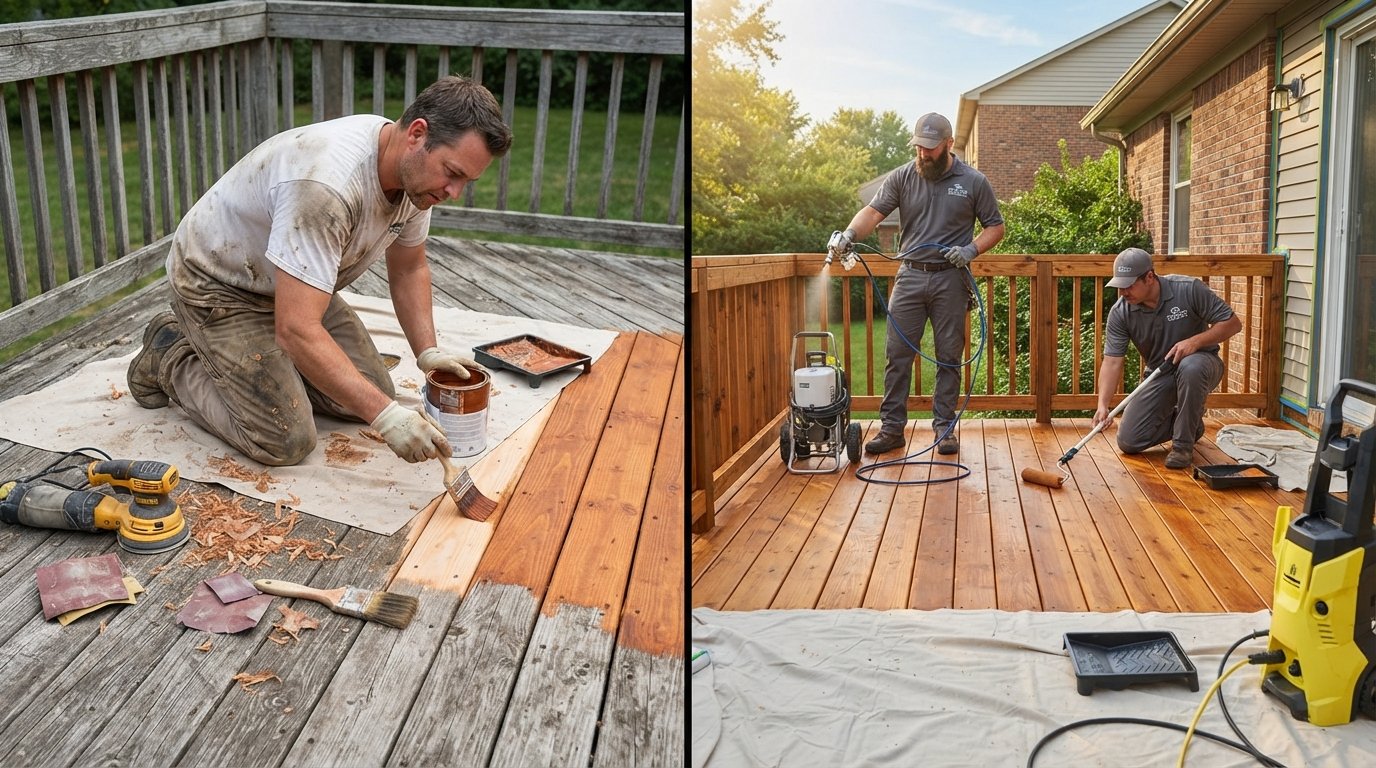
DIY vs Professional Deck Staining Cost and Results
Compare DIY vs professional deck staining cost and results, from $200 DIY materials to $1,200 pro jobs, and learn which option protects your deck longer.

By Zoe Harper
Learn more about Deck Staining and Sealing for guides, costs, and what to expect.
Compare Deck Staining and Sealing Pros Near You

Enter your ZIP code to compare top-rated local professionals and request free quotes.
Your deck survived another winter, but it is looking tired. The boards are gray, the finish is flaking, and every time you walk across it, you leave a trail of splinters and dust on your socks. You know it needs staining, and you have a decision to make: grab a bucket and brush this weekend, or write a check and let a crew handle it. The gap between those two choices is wider than most homeowners expect, and it shows up in three places: your wallet, your calendar, and the finish that greets you next spring. Understanding the real numbers behind DIY vs professional deck staining cost and results before you buy a single gallon of stain will save you hundreds of dollars and a full weekend of regret.
What Deck Staining Actually Involves
Staining a deck is not painting a fence. Paint sits on top of wood and hides it. Stain penetrates the fibers, protects against UV rays and moisture, and needs the wood to be in the right condition to absorb it. That means the job has several distinct phases, and skipping any one of them is why so many DIY staining projects fail within a year. First comes cleaning: removing dirt, mildew, and the gray dead wood fibers on the surface. Second comes sanding or stripping if there is an old failing finish. Third comes brightening or neutralizing the wood after cleaning. Fourth comes drying time, which can take 24 to 48 hours depending on humidity. Only then does the actual staining begin, followed by a second coat and a curing period where no furniture or foot traffic touches the surface.
Professionals bring more than labor to this sequence. They bring moisture meters, commercial-grade cleaners, and the experience to know whether your deck needs a full strip or just a refresh. They also know which stain products hold up in your specific climate. A cedar deck in the Pacific Northwest faces different threats than a pressure-treated pine deck in Arizona, and the wrong product choice can mean a failed finish in under 12 months. When you compare DIY vs professional deck staining cost and results, you are not just comparing an hourly rate. You are comparing a homeowner guessing at prep versus someone who has prepped hundreds of decks and knows what goes wrong.
There is also a safety and logistics layer that homeowners often underestimate. Many decks have railings, stairs, and spindles that multiply the surface area you must coat. A 300-square-foot deck can easily have 500 square feet of actual staining surface once you count balusters and handrails. Ladders, slippery wet wood, and chemical strippers add risk. None of this makes DIY impossible, but it does explain why so many weekend warriors end up calling a professional halfway through the project, which is the most expensive outcome of all.
The Real Cost of DIY Deck Staining
On paper, DIY looks cheap. A gallon of quality stain runs $30 to $60, and a 300-square-foot deck typically needs two to three gallons for two coats. Add a cleaner, a brush, a roller, sandpaper, and a pump sprayer, and most homeowners land between $150 and $350 in materials. That number is real, and it is the reason DIY remains popular. But it is not the full picture.
Consider what else goes into the job. You need two to three full days of labor, minimum, spread across a week because of drying times. If you take unpaid time off work, that is a direct cost. If you value your weekend at $30 an hour, a 16-hour project costs $480 in opportunity cost alone. Then there is the risk of mistakes: over-application that stays tacky for weeks, lap marks from staining in direct sun, or a failed strip job that leaves you paying a professional to fix your work. Redoing a botched stain job often costs more than hiring a pro the first time because the contractor has to strip your failed product before starting fresh.
Here is a realistic DIY budget breakdown for a 300-square-foot deck with railings:
- Stain (2 to 3 gallons of quality oil or water-based product): $90 to $180
- Deck cleaner and brightener: $25 to $50
- Brushes, rollers, pads, and sprayer: $40 to $80
- Sanding supplies and sandpaper: $20 to $40
- Drop cloths, tape, and personal protective equipment: $20 to $35
- Total materials: $195 to $385
That range assumes you already own a ladder, a power washer, and basic tools. If you need to rent a power washer, add $50 to $80 per day. If your deck has an old failing finish that needs chemical stripping, add another $60 to $120 in stripper alone. Suddenly the DIY number is creeping toward $500, and you have not stained a single board yet.
The hidden cost that catches most homeowners is time. Staining is weather-dependent. If rain arrives on day two, you lose the window and start over. If the temperature drops below the product's minimum, the stain will not cure properly. If you apply the second coat too soon, the finish will peel. These are not hypothetical problems. They are the most common reasons DIY deck staining fails, and they are exactly the variables a professional crew manages every day.
What Professional Deck Staining Costs
Professional deck staining prices vary by region, deck size, condition, and the type of stain used. Nationally, most homeowners pay between $2 and $5 per square foot for cleaning and staining, with the average project landing around $850 to $1,200 for a standard 300-square-foot deck with railings. In high-cost metros, that can climb to $1,500 or more. In rural areas with lower labor rates, it can drop to $600 to $800.
What does that price include? A reputable contractor typically provides power washing, mildew treatment, sanding of rough spots, minor board repair, stain application, and cleanup. Some include a warranty on workmanship, typically one to two years. That warranty matters. If the stain peels or fails prematurely, the contractor returns and fixes it at no charge. No DIY homeowner gets that protection.
Stain type also drives the price. A basic transparent or semi-transparent stain costs less per gallon than a high-solids solid stain or a premium penetrating oil. Labor is the bigger variable. Decks with extensive railings, multiple levels, or difficult access take longer and cost more. Decks that have never been stained or that have years of neglect may require extra prep, which adds labor hours.
The smartest way to compare quotes is to ask each contractor exactly what is included. Some low bids skip sanding or skip the brightening step. Those shortcuts show up as premature failure. A detailed quote that lists every step is worth more than a cheap quote that leaves you guessing. If you want to compare local deck staining estimates without calling a dozen companies, a service like HomeRemodelingsContractors can connect you with experienced contractors in your area who provide free, no-obligation quotes.
Results: How DIY and Professional Finishes Compare
The finish is where the two paths diverge most visibly. A properly prepared and applied professional stain penetrates evenly, cures to a uniform color, and typically lasts three to five years before needing a recoat. A DIY job done carefully can match that. A DIY job done hastily, in the wrong conditions, or with poor prep often fails within 12 to 18 months. The difference is not talent. It is process control.
Professionals control variables that homeowners cannot easily manage. They choose application days based on humidity and temperature forecasts. They use sprayers for large flat areas and back-brush immediately for even penetration. They know how to avoid lap marks by working in manageable sections and keeping a wet edge. They also know which stains perform best on your wood species. These details determine whether your deck looks brand new for four years or starts peeling by next summer.
There is also the question of appearance expectations. A semi-transparent stain shows the wood grain and is more forgiving of minor application inconsistencies. A solid stain hides grain and imperfections but shows every lap mark and drip. If you choose a solid stain for your DIY project, you need near-professional technique to get a clean result. If you choose a semi-transparent stain, you have more margin for error, but you still need proper prep to avoid blotchiness.
Warranty and recourse are part of the results equation too. If a professional job fails early, you call the contractor. If your DIY job fails, you buy more product and start over. That asymmetry is worth factoring into your decision, especially if your deck is large or your time is limited.
When DIY Makes Sense and When It Does Not
DIY deck staining is a reasonable choice in specific situations. If your deck is small (under 200 square feet), in good condition, and has no failing finish, you can handle the job in a weekend with basic tools. If you enjoy the work, have flexibility in your schedule, and are comfortable with the prep steps, DIY saves real money. If you are staining a new deck for the first time and the wood is clean and dry, the job is simpler than most homeowners expect.
Professional staining makes more sense when any of the following apply:
- Your deck is larger than 300 square feet or has extensive railings and stairs
- The existing finish is peeling, flaking, or uneven and needs stripping
- You have limited time, physical limitations, or no safe way to access the deck
- You want a warranty and a single point of accountability if something goes wrong
- Your climate has short staining windows or frequent rain
There is also a middle path worth considering. Some homeowners handle the cleaning and prep themselves, then hire a professional for the actual stain application. This reduces labor costs while still getting a professional finish. It requires coordination and clear communication about who does what, but it can be a smart compromise for budget-conscious homeowners who are willing to do some of the work.
If you are planning a larger outdoor project alongside your deck staining, such as new railings, stairs, or built-in seating, it helps to think about the whole scope at once. A guide on cabinet installation cost and pro tips shows how planning multiple improvements together can reduce total labor costs and prevent sequencing mistakes. The same logic applies outdoors: bundling deck repairs, staining, and railing upgrades into one project often costs less than tackling them separately.
How to Get Accurate Local Quotes
If you decide to hire a professional, the quality of your outcome depends heavily on the quality of your contractor. The lowest bid is rarely the best value. Ask each contractor for references from similar projects, proof of insurance, and a written scope of work that lists every prep step and the specific stain product they plan to use. A contractor who cannot answer basic questions about prep and product is not the right choice.
Timing matters too. Late spring and early summer are peak deck staining season, and good contractors book out weeks in advance. Late summer and early fall are often easier windows, and the weather is still favorable in most regions. Scheduling your project in a shoulder season can sometimes get you better pricing and more attention.
Finally, think about the long game. A deck stained correctly lasts three to five years. A deck stained poorly lasts one to two. Over a decade, the professional job that costs $1,000 today may cost less than two DIY jobs at $400 each plus the time and frustration of redoing failed work. When you weigh DIY vs professional deck staining cost and results across a full maintenance cycle, the math often favors the professional, especially for larger decks and homeowners with limited time.
Your deck is an extension of your home, and it deserves a finish that protects your investment and looks good doing it. Whether you tackle the job yourself or bring in a pro, the prep you do and the product you choose matter more than the brush you hold. Start with a clear plan, get real quotes, and pick the path that fits your budget and your calendar.