
Curbless Shower Installation Cost: Real Numbers for 2026
Curbless showers run $4,000 to $12,000 installed. See what drives the price and call (833)-365-8755 for free local contractor estimates.

By Oliver Grant
Learn more about Shower and Bathtub Installation or Replacement for guides, costs, and what to expect.
Compare Shower and Bathtub Installation or Replacement Pros Near You

Enter your ZIP code to compare top-rated local professionals and request free quotes.
A curbless shower looks effortless: a smooth, seamless transition from bathroom floor to shower floor, no lip to step over, no barrier to trip on. That clean look is exactly why it has become the go-to choice for aging-in-place remodels, universal design projects, and modern bathroom upgrades. But behind that simple visual is one of the most technically demanding installations in residential remodeling, and the price reflects it. If you are asking how much does a curbless shower cost to install, the honest answer is that most homeowners spend between $4,000 and $12,000 for the shower alone, with a full bathroom remodel that includes one often landing between $15,000 and $30,000. The wide range comes down to waterproofing method, drain type, subfloor structure, tile selection, and local labor rates. This guide breaks down those numbers so you can budget with confidence instead of guesswork.
What Drives the Cost of a Curbless Shower Installation
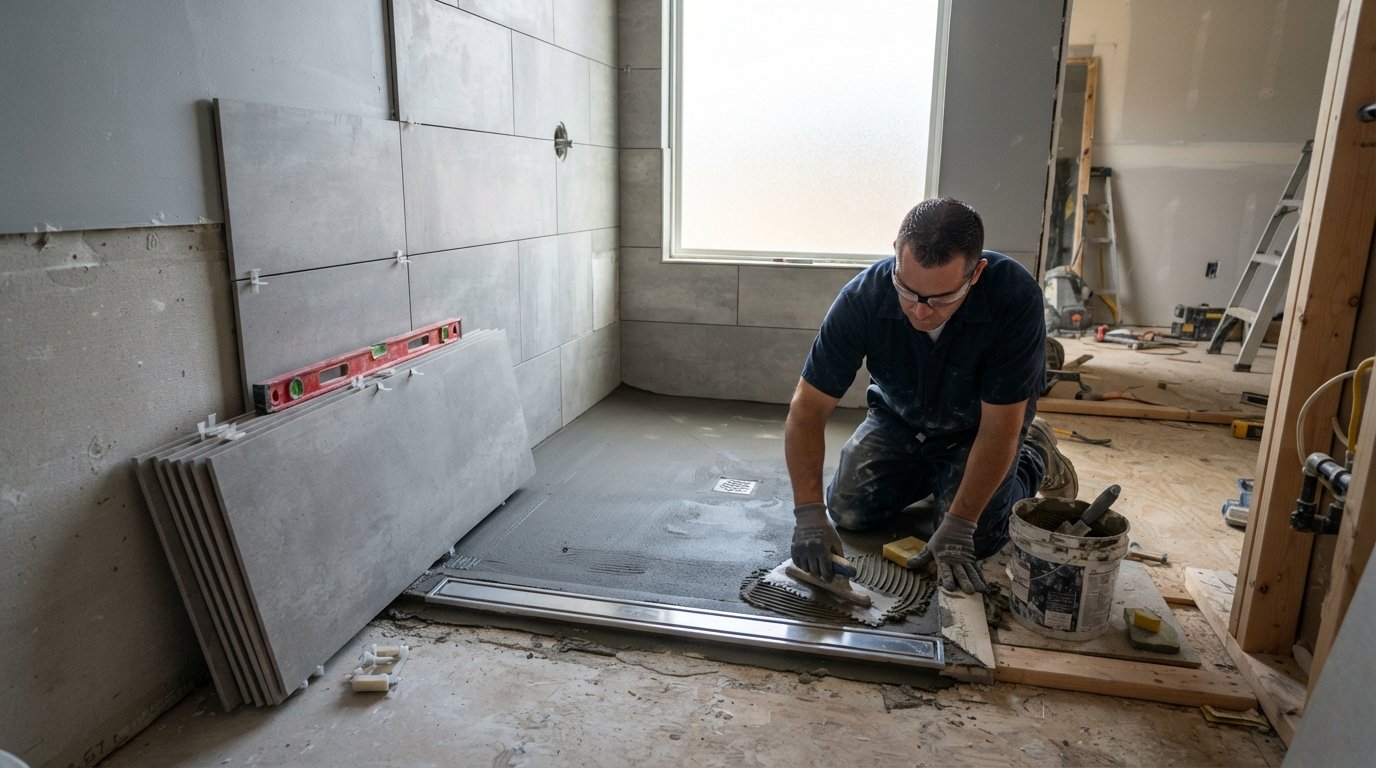
A standard shower with a curb is a relatively forgiving project. Water stays inside a raised pan, and gravity does most of the work. A curbless shower removes that safety net, so every layer of the assembly has to be precise. The shower floor must slope toward the drain at the correct pitch, the waterproofing must be continuous and flawless, and the framing must support a recessed floor without compromising the structure. Each of those requirements adds labor, materials, and specialized skill.
The biggest single cost driver is how the installer creates the slope. There are two main approaches. The first is a recessed subfloor, where the framing is lowered so the shower floor sits flush with the bathroom floor. The second is a surface-applied slope system, where a pre-sloped foam pan or mortar bed is built up on top of the existing floor and the rest of the bathroom is raised to match. Recessing the subfloor is more labor-intensive because it involves cutting and reinforcing joists, but it produces the cleanest result and avoids a step up into the bathroom. Surface systems are faster and often cheaper, but they can create a small threshold at the bathroom entry that some homeowners dislike.
Waterproofing is the next major factor. Curbless showers demand a bonded waterproofing membrane, often a liquid-applied coating or a sheet membrane, that extends across the entire shower floor and up the walls. Linear drains, which are the most common choice for curbless designs, cost more than standard center drains, typically $300 to $1,200 for the drain assembly alone, and they require precise framing and tile work to install correctly. Add in the tile, which must be small enough or properly pitched to follow the slope, and the material costs climb further.
Labor is where the numbers really separate. A skilled tile setter who understands shower slope and waterproofing may charge $60 to $120 per hour, and a curbless shower can take two to four days of dedicated work before tile even begins. In high-cost metro areas, labor alone can push the installation past $10,000. In lower-cost regions, the same scope might come in closer to $4,500. That geographic spread is why national averages are only a starting point.
A Realistic Cost Breakdown by Component
To understand how much does a curbless shower cost to install, it helps to see where the money goes. The following ranges reflect typical mid-range materials and professional labor in 2026. They assume the shower is part of a bathroom remodel rather than a standalone retrofit, since most curbless projects involve at least some surrounding floor work.
- Demolition and disposal: $500 to $1,500, including removing the old shower, tile, and any framing changes.
- Framing and subfloor modification: $800 to $3,000, depending on whether joists must be cut and reinforced for a recessed pan.
- Plumbing rough-in and linear drain: $700 to $2,000, including moving the drain, installing the linear drain body, and pressure testing.
- Waterproofing system: $600 to $1,800 for membrane, sealant, and associated trim pieces.
- Tile and setting materials: $1,200 to $5,000, driven largely by tile choice and square footage.
- Labor for installation: $1,500 to $5,000, depending on local rates and complexity.
- Glass enclosure and door: $800 to $3,500 for a frameless or semi-frameless system.
- Permits and inspection fees: $150 to $600, varying by jurisdiction.
Added together, a modest curbless shower with basic tile and a semi-frameless door can land near $4,000 to $6,000 in a lower-cost market. A larger shower with premium tile, a frameless glass enclosure, and a recessed subfloor in a major metro area can easily exceed $12,000. The key takeaway is that the shower itself is rarely the whole project. Flooring transitions, painting, and vanity updates often get pulled in once the bathroom is opened up, which is why whole-bath budgets climb so quickly.
If you are weighing this against other accessible options, our comparison of a walk in tub vs curbless shower breaks down the tradeoffs in cost, safety, and resale appeal. Walk-in tubs often cost less upfront but require more structural and plumbing work than homeowners expect, while curbless showers tend to deliver better long-term usability and a stronger return on investment.
Curbless Versus Walk-In Tub for Aging in Place
For homeowners planning to stay in their homes as they age, the choice between a curbless shower and a walk-in tub is one of the most consequential decisions in a bathroom remodel. Both eliminate the high step that makes traditional tubs and showers risky, but they serve different needs and carry different cost profiles.
A walk-in tub typically costs $3,000 to $8,000 installed for a basic model, with premium therapeutic features pushing well past $15,000. It requires a dedicated plumbing upgrade, often a larger water heater, and it takes up more floor space than a shower. The door must seal tightly, and the user must wait for the tub to fill and drain before exiting, which can be a drawback for anyone with limited mobility or circulation issues. A curbless shower, by contrast, allows immediate entry and exit, works with a shower chair or bench, and integrates seamlessly into a modern bathroom design. Its installed cost is often comparable or slightly higher than a mid-range walk-in tub, but it adds usable space and generally appeals to a broader range of future buyers.
From a resale perspective, a well-executed curbless shower reads as a luxury upgrade rather than a medical fixture. Real estate agents consistently report that walk-in tubs can be a hard sell to buyers without mobility concerns, while a zero-threshold shower with clean tile and frameless glass feels spa-like and universally appealing. For aging-in-place plans, many contractors recommend a curbless shower with a linear drain, a built-in bench, and blocking in the walls for future grab bars. That combination delivers safety now and flexibility later without sacrificing design.
One important caveat: not every bathroom can accommodate a curbless shower without significant structural work. If the shower is on a second floor or above a finished ceiling, recessing the subfloor may require engineering and additional framing. In those cases, a surface-applied slope system with a small threshold may be the more practical choice, and the cost difference can be substantial. A reputable contractor will evaluate the framing before quoting, not after demolition begins.
Permits, Inspections, and Code Requirements
Curbless shower installations almost always require a permit, and for good reason. The work involves altering plumbing, modifying framing, and installing a waterproofing system that, if done wrong, can cause hidden water damage for years. Most building departments classify this as a plumbing and structural alteration, and some require a separate electrical permit if heated floors or new lighting are added.
Permit fees typically run $150 to $600 for a bathroom remodel, though some jurisdictions charge based on project valuation and the fee can climb higher for larger jobs. The inspection process usually involves at least two visits: one after rough plumbing and framing, and one after waterproofing but before tile. Some inspectors want to see the waterproofing membrane and a flood test, where the shower pan is filled with water for 24 hours to confirm no leaks. Skipping the permit to save money is a false economy. Unpermitted work can complicate a future home sale, void insurance claims, and force expensive corrections if a buyer's inspector flags it.
Code requirements vary, but several apply broadly. The shower floor must slope at least one quarter inch per foot toward the drain. The drain must be accessible for cleaning and repair. Grab bar blocking is not always mandatory in a private residence, but it is strongly recommended for aging-in-place designs and may be required in some jurisdictions for accessible renovations. Glass enclosures must be tempered safety glass. If the project includes a curbless design in a commercial or multi-family setting, ADA guidelines may apply, and those are stricter than residential code.
Before hiring anyone, confirm that the contractor will pull the permit in their name and schedule inspections. A professional who suggests skipping the permit or lets the homeowner pull it is a red flag. The permit and inspection process is there to protect your investment, and a contractor who understands curbless shower assemblies will treat it as routine rather than an obstacle.
Maintenance and Leak Risk to Anticipate
A curbless shower is a high-performance assembly, and like any high-performance system, it demands proper maintenance. The most common failure point is the waterproofing layer, particularly at the drain connection and the floor-to-wall junctions. If the membrane is punctured during tile installation or if the linear drain is not sealed correctly, water can migrate under the tile and into the subfloor. By the time a stain appears on the ceiling below, the damage is often extensive.
Homeowners can reduce that risk in several practical ways. First, insist on a flood test before tile goes down, and ask for photos of the waterproofing before it is covered. Second, choose a contractor who uses a proven system from a single manufacturer, such as a bonded membrane with matching drain and sealant, rather than mixing products from different brands. Third, plan to reseal grout and silicone joints annually, and keep the linear drain cover clean so water does not pool. Fourth, address any movement or cracking in the tile or grout promptly, since small cracks can let water into the assembly.
Long-term maintenance also includes watching for efflorescence, a white mineral deposit that can appear on tile or grout when moisture is moving through the assembly. It is not always a sign of failure, but it warrants investigation. In hard-water areas, a water softener or regular descaling helps preserve the drain and tile finish. None of this is onerous, but it is more attention than a traditional shower requires, and homeowners should factor it into their decision.
From a cost perspective, budgeting $100 to $300 per year for professional inspection and maintenance is a reasonable safeguard on a $10,000 installation. It is far cheaper than tearing out a failed shower pan, which can cost $5,000 or more once tile, waterproofing, and framing repairs are included. A curbless shower done right is a durable, beautiful feature. A curbless shower done cheaply is a liability.
How to Budget and Hire the Right Contractor
Because curbless showers require specialized skill, the contractor you choose matters as much as the materials. A general handyman who has tiled a few backsplashes is not the right fit. Look for a contractor with documented experience in bonded waterproofing systems, linear drains, and curbless or zero-threshold assemblies. Ask to see photos of past projects, and ask specifically how they handle the slope and the flood test.
Getting multiple quotes is essential, but compare scope carefully. One bid may include a recessed subfloor and a flood test, while another may propose a surface-applied pan with no inspection. The lower number is not always the better deal. A clear, itemized proposal should list demolition, framing, plumbing, waterproofing, tile, glass, and permits separately so you can see what is included and what is not. For homeowners who want to compare vetted local professionals without the guesswork, HomeRemodelingsContractors connects you with experienced contractors who understand complex bathroom assemblies and can provide free estimates for your project.
A realistic timeline for a curbless shower installation is two to four weeks from demolition to final inspection, assuming materials are on hand and no structural surprises emerge. Custom glass can add another week or two. Plan for a contingency of 15 to 20 percent on top of the quoted price, since opening a floor often reveals issues that were not visible before. Homeowners who budget that cushion rarely regret it, while those who spend to the limit often find themselves making compromises on waterproofing or tile quality at the worst possible moment.
Finally, think about the whole bathroom, not just the shower. A curbless shower changes the floor height and tile layout, which often means new flooring throughout the bathroom and adjustments to the vanity and toilet placement. Those ripple effects are part of the real cost. A contractor who flags them upfront is one worth hiring. One who quotes only the shower and leaves the surprises for later is not.
How much does a curbless shower cost to install? For most homeowners, the answer lands between $4,000 and $12,000 for the shower itself, and $15,000 to $30,000 for a full bathroom remodel that includes one. The variables are real, but they are knowable. With a clear scope, a contractor who specializes in waterproofing, and a budget that includes a contingency, a curbless shower can be one of the smartest, safest, and most beautiful upgrades a home can offer.