
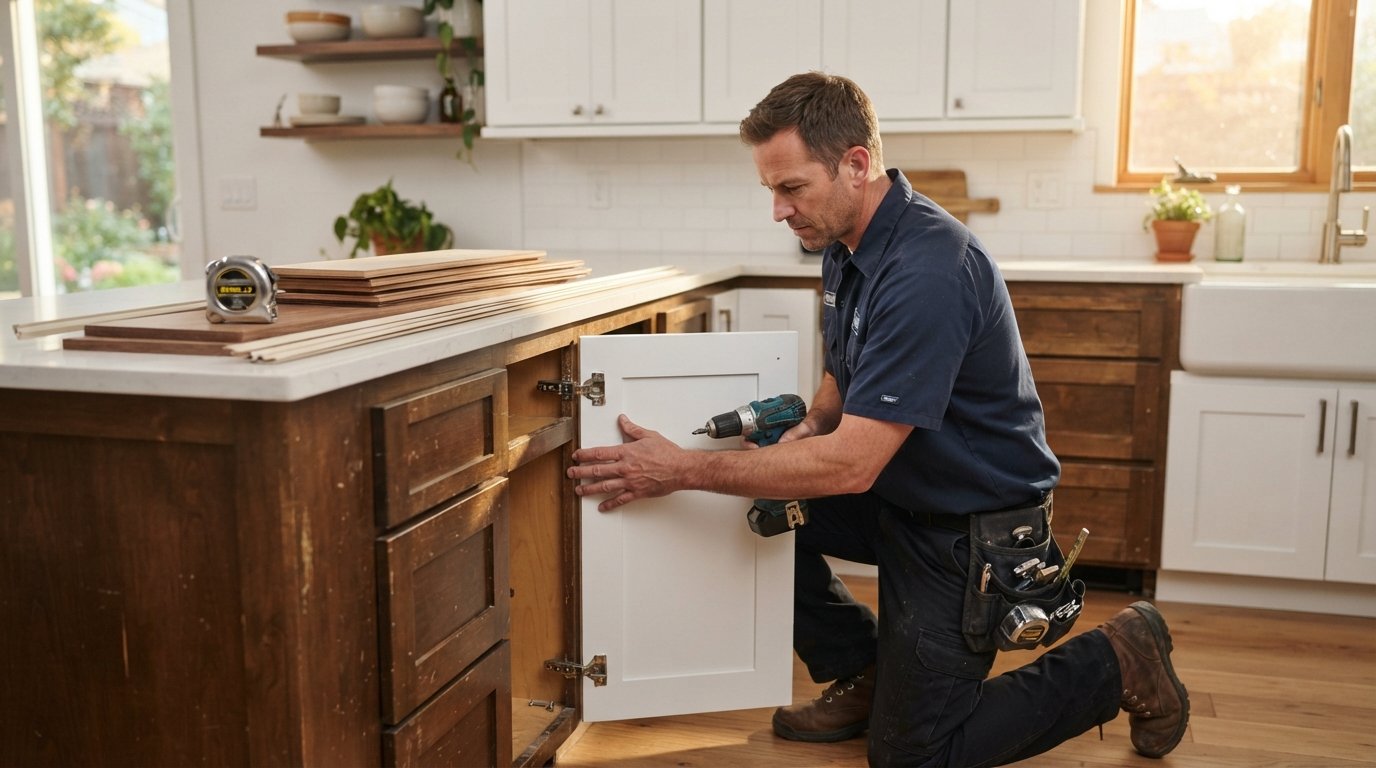
Average Cost to Reface Kitchen Cabinets per Linear Foot
Refacing costs $150 to $450 per linear foot, far less than replacement. Call (833)-365-8755 to compare local contractor estimates and start your kitchen refresh.

By Zoe Harper
Learn more about Cabinet Refinishing and Repair for guides, costs, and what to expect.
Compare Cabinet Refinishing and Repair Pros Near You

Enter your ZIP code to compare top-rated local professionals and request free quotes.
Your kitchen cabinets take up a huge share of your remodeling budget, often as much as 40 percent, so it makes sense to look for a refresh that costs less than a full replacement. Refacing is one of the few projects that can change the entire look of your kitchen without tearing out the boxes. The average cost to reface kitchen cabinets per linear foot typically runs from $150 to $450, but that range hides a lot of variation. Material choice, door style, and add-ons all move the number up or down. This guide breaks down the per-foot pricing so you can measure your own kitchen and build a realistic budget before you call a contractor.
What Drives the Average Cost to Reface Kitchen Cabinets per Linear Foot
Refacing keeps your existing cabinet boxes and replaces the visible surfaces: the doors, drawer fronts, and veneer on the frame. Because the structural work is minimal, labor and material costs stay far below a full replacement. The per-linear-foot price is simply the total project cost divided by the linear feet of cabinetry you are updating. A linear foot is measured along the front face of the cabinets, not the floor area.
Three factors account for most of the spread in pricing. First, the material you choose for doors and veneer sets a baseline. Second, the door style and profile affect both material waste and labor time. Third, the condition of your existing boxes matters: if the frames are damaged or uneven, prep work adds cost. A simple laminate veneer with flat doors sits at the low end, while a real wood veneer with raised-panel doors and a glazed finish lands at the high end.
It also helps to separate material costs from labor. On average, materials account for roughly 40 to 50 percent of the per-foot price, and labor makes up the rest. That split matters when you compare quotes, because a low labor rate can signal a rushed job, and a high material cost may mean you are paying for upgrades you did not ask for. Ask each contractor to break out materials and labor so you can compare apples to apples.
Per-Linear-Foot Pricing by Material and Door Style
The table below shows typical installed costs per linear foot for common refacing packages. These figures include doors, drawer fronts, veneer, and standard hardware, but they exclude add-ons like crown molding and glass inserts, which are covered later.
- Laminate veneer with flat slab doors: $150 to $220 per linear foot. Best for modern, budget-focused kitchens.
- Rigid thermofoil (RTF) with shaker doors: $180 to $280 per linear foot. A popular middle ground with a painted look and easy cleaning.
- Real wood veneer with raised-panel doors: $250 to $380 per linear foot. Adds warmth and traditional character.
- Premium wood veneer with custom or glazed doors: $350 to $450 per linear foot. Highest-end look with detailed finishes.
Door style matters as much as material. A flat slab door is the least expensive to produce because there is no frame or panel to assemble. Shaker doors cost a bit more but remain budget-friendly and suit most home styles. Raised-panel and custom doors require more machining and finishing time, which pushes the per-foot price toward the top of the range. If you love the look of a glazed or distressed finish, expect to pay for the extra handwork.
One practical tip: you do not have to use the same material everywhere. Many homeowners choose a premium veneer on the upper cabinets, which are more visible, and a mid-range option on the lower cabinets. This strategy can trim 10 to 15 percent off the total while keeping the look consistent from eye level.
How to Measure Your Kitchen Cabinets for an Accurate Quote
Getting a reliable per-foot estimate starts with an accurate measurement. You can do this yourself in about 15 minutes with a tape measure and a notepad. Contractors will verify your numbers, but having them ready helps you sanity-check quotes and spot inflated estimates.
- Measure each run of cabinets along the front face, from the left edge of the first cabinet to the right edge of the last one. Record the length in inches.
- Add up the lengths of all runs, including upper cabinets, lower cabinets, and any island or peninsula cabinetry. Treat each as a separate run.
- Divide the total inches by 12 to get linear feet. For example, 240 inches of cabinetry equals 20 linear feet.
- Note the number of doors and drawers separately. Some contractors price per door and drawer front rather than per foot, so this cross-check keeps quotes honest.
- Take photos of the cabinet frames, corners, and any damaged areas so you can share them when requesting estimates.
Once you have your linear footage, multiply it by the per-foot range for your preferred material. A 20-foot kitchen at $200 per foot comes to about $4,000, while the same kitchen at $400 per foot comes to $8,000. That simple calculation gives you a working budget before any contractor sets foot in your home. It also helps you decide whether refacing or full replacement makes more sense for your layout.
If your kitchen has an unusual layout with many angles, islands, or floor-to-ceiling cabinets, add 10 percent to your measurement as a buffer. Complex layouts take longer to template and install, and the buffer prevents surprise overages.
Add-On Costs: Crown Molding, Glass Inserts, and Soft-Close Hinges
Base refacing prices rarely include the details that make a kitchen feel custom. These add-ons are priced separately, and they can add 15 to 30 percent to your total. Knowing the going rate for each helps you decide which upgrades are worth it.
- Crown molding: $10 to $25 per linear foot installed. It finishes the top of the cabinets and hides the gap between the cabinet and ceiling.
- Glass inserts: $75 to $150 per door. Frosted or seeded glass adds light and display space, but expect higher costs for tempered glass.
- Soft-close hinges and drawer slides: $15 to $40 per door or drawer. One of the most requested upgrades because it eliminates slamming and adds a premium feel.
- New hardware (pulls and knobs): $5 to $20 per piece. Budget-friendly hardware can transform the look for a few hundred dollars.
- Under-cabinet lighting: $200 to $600 for the full run. Improves task lighting and makes the new veneer look richer.
Prioritize add-ons by how much they affect daily use. Soft-close hinges are worth the money because they protect the new doors and reduce noise. Crown molding delivers a big visual payoff for a modest cost, especially in kitchens with ceilings under nine feet. Glass inserts are the most discretionary: they look great but require tidy cabinets and add the most per door.
Ask your contractor to itemize add-ons in the quote rather than bundling them into a single per-foot price. Bundling makes it hard to compare bids and easy to overpay for features you may not need. A transparent quote lists each upgrade with its own price and quantity.
How Refacing Fits into Your Overall Kitchen Budget
Refacing is often the centerpiece of a budget-conscious kitchen refresh, but it is rarely the only line item. A realistic budget accounts for the surrounding work that makes the new cabinets look intentional. Countertops, backsplash, flooring, and paint all interact with the cabinet finish, and skipping them can make even new doors look out of place.
A typical mid-range kitchen refresh with refacing breaks down like this: refacing at 40 to 50 percent of the budget, new countertops at 20 to 25 percent, backsplash and paint at 10 to 15 percent, and the remainder for lighting, hardware, and contingency. On a $12,000 refresh, that puts refacing around $5,000 to $6,000, which aligns with 25 to 30 linear feet at mid-range pricing. Keeping a 10 percent contingency is smart, because older kitchens often reveal small surprises once the old doors come off.
Refacing also competes well against full replacement on value. A full cabinet replacement can run two to three times the cost of refacing, and it often triggers related work like countertop removal and drywall repair. If your boxes are solid and the layout works for you, refacing delivers most of the visual impact for a fraction of the price. If the boxes are sagging, water-damaged, or the layout needs to change, replacement is the better path.
For homeowners planning a broader exterior project alongside the kitchen, our guide on the average cost to replace a garage door and ROI in 2026 shows how to weigh per-project spending against long-term returns. The same logic applies indoors: spend where the visible impact is highest and the structural work is lowest.
Getting Quotes and Choosing a Contractor
Refacing is a detail-heavy job, and the quality of the install shows in the seams, alignment, and finish. Get at least three quotes and ask each contractor the same set of questions. A good quote lists the veneer and door materials by brand, the number of doors and drawers, the hardware, and the timeline. It should also state who handles template measurement and whether the price includes removal and disposal of the old doors.
Check experience with refacing specifically, not just general remodeling. Ask to see photos of completed refacing jobs and, if possible, speak with a past client. Confirm licensing and insurance, and get the payment schedule in writing. A deposit of 10 to 30 percent is normal, with the balance due after a walkthrough. Avoid contractors who demand most of the money upfront or who will not put the scope in writing.
If you want help comparing vetted local pros, HomeRemodelingsContractors connects homeowners with experienced contractors for remodeling and repair projects, and the free estimate process makes it easy to compare options side by side. Use those estimates to benchmark per-foot pricing and to confirm what each bid includes. The lowest bid is not always the best value: a quote that is 20 percent below the others often leaves out prep work, hardware, or cleanup.
Finally, schedule the work when you can tolerate a few days of disruption. Refacing typically takes two to five days for an average kitchen, plus a week or two of lead time for doors and veneer to be fabricated. Plan meals and kitchen access around the install window, and clear the countertops before the crew arrives.
The average cost to reface kitchen cabinets per linear foot gives you a reliable starting point for budgeting, but the real number depends on your measurements, material choices, and add-ons. Measure carefully, itemize your upgrades, and compare at least three detailed quotes. With those steps, you can refresh your kitchen for a fraction of a full remodel and still get a result that looks custom-built.