
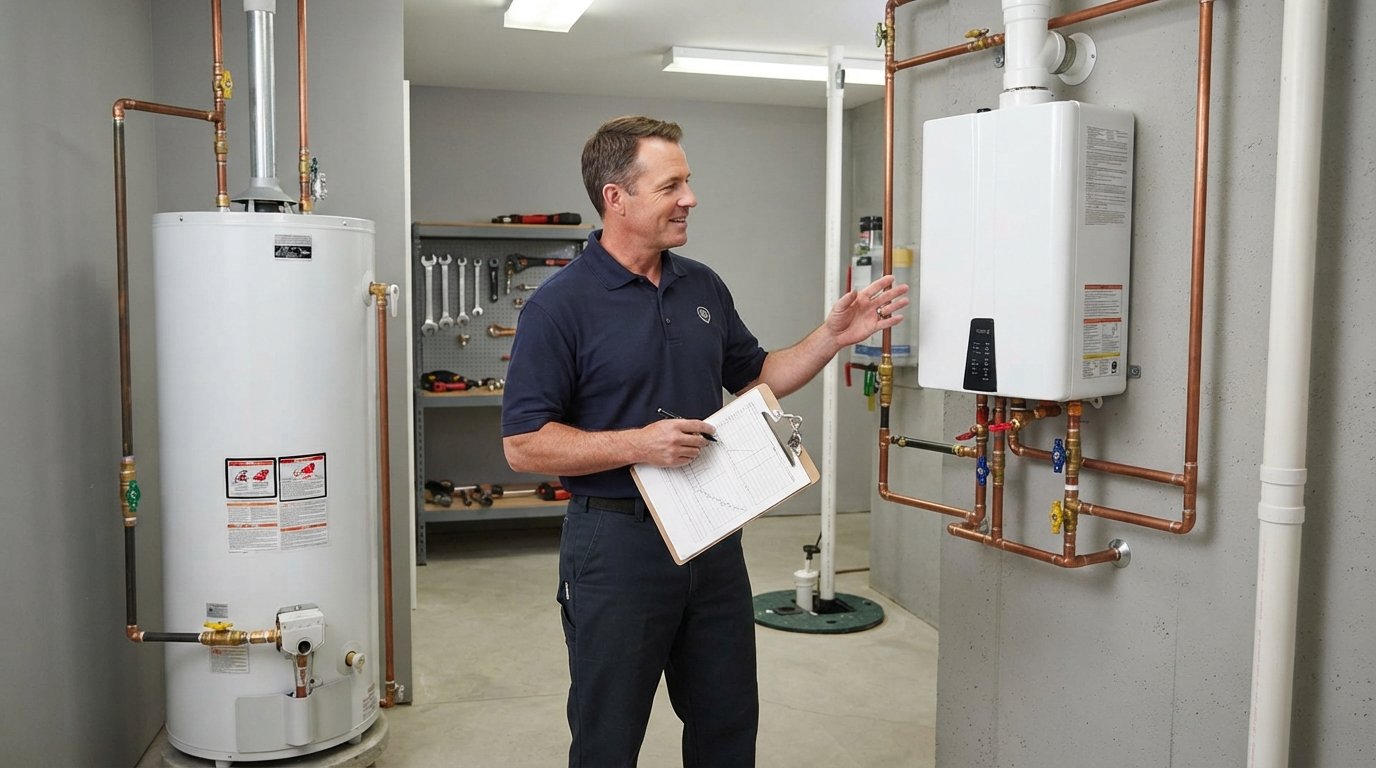
Tankless vs Tank Water Heater Cost: A Real Comparison
Compare tankless vs tank water heater cost comparison with real installed prices and savings. Call (833)-365-8755 to plan your upgrade.

By Valerie Nguyen
Learn more about Water Heater Installation or Replacement for guides, costs, and what to expect.
Compare Water Heater Installation or Replacement Pros Near You

Enter your ZIP code to compare top-rated local professionals and request free quotes.
Your old water heater is on its last legs, and you are staring at two very different price tags: a few hundred dollars for a tank model versus a few thousand for a tankless unit. The sticker shock is real, but the sticker price is not the whole story. A true tankless vs tank water heater cost comparison has to look at the installed price, the hidden requirements that change your quote, the lifespan of each system, and how much energy you actually save. Get those numbers wrong, and you either overpay upfront or underestimate the long-term bill. This guide breaks down each cost layer so you can compare plumbing contractor estimates with confidence and choose the system that fits your home and budget.
The Installed Cost Gap: What You Actually Pay
The first number most homeowners see is the retail price of the unit itself. A standard 40 to 50 gallon tank water heater typically costs between $500 and $1,200 depending on capacity, warranty, and whether it is gas or electric. A whole-house tankless unit usually runs from $1,000 to $2,500 for the equipment alone. That gap is real, but it is only the opening act. The installed cost, which includes labor, materials, permits, and any required upgrades, is where the comparison gets interesting.
For a straightforward replacement, installing a tank water heater might cost $800 to $1,500 in labor and materials, bringing the total installed price to roughly $1,300 to $2,700. A tankless installation often lands between $2,500 and $5,000 installed, and sometimes higher if your home needs electrical, gas, or venting upgrades. The wide range exists because tankless units are not drop-in replacements. They demand specific conditions to operate safely and efficiently, and meeting those conditions is where budgets stretch.
Here is the key takeaway: the installed cost difference is usually $1,500 to $3,000 more for tankless. That premium buys you a longer lifespan, lower energy bills, and unlimited hot water, but only if the installation is done correctly. Skipping the required upgrades to save money upfront often leads to performance problems and costly repairs later. A reputable plumbing contractor will spell out those requirements in the estimate, and you should treat any quote that ignores them as a red flag.
Venting, Electrical, and Gas Line Requirements That Change the Quote
Tankless water heaters are power-hungry and need precise venting, which is why the installation quote can swing by thousands of dollars. A gas tankless unit typically requires a stainless steel vent pipe that runs horizontally out a wall, and the vent length and configuration are limited by the manufacturer. If your home does not have a suitable exterior wall near the installation point, you may need to reroute the vent, which adds labor and materials. Older homes with masonry walls or tight mechanical rooms can turn a simple vent run into a major project.
Gas line sizing is another common surprise. Tankless units fire at a much higher BTU input than tank models, often 150,000 to 200,000 BTUs compared to 40,000 for a tank. If your existing gas line is undersized, the contractor must run a larger diameter line from the meter, which can add $500 to $1,500 depending on the distance and accessibility. Electrical requirements matter too. Most gas tankless units need a dedicated 120 volt circuit for the controls and fan, and electric tankless models may require 240 volt service with multiple dedicated circuits and a panel upgrade. An electrical panel upgrade alone can cost $1,500 to $3,000, and that number rarely appears in online cost estimates.
Condensing tankless units add another wrinkle: they produce acidic condensate that must be drained according to local code, often through a neutralizer kit. That is a small line item, but it is one more requirement that a tank water heater does not have. When you compare estimates, ask the contractor to itemize each of these categories so you can see exactly what is included and what is assumed. The lowest bid is often the one that quietly omits the gas line upgrade or the vent relocation, and you will pay for it later.
If your project expands beyond the water heater, perhaps because the mechanical room needs waterproofing or the utility area is part of a larger remodel, it helps to understand related costs. Our guide on basement waterproofing methods and cost comparison explains how moisture control and utility upgrades can be planned together, which is useful if your water heater sits in a basement that needs attention.
Lifespan and Energy Savings: The Long Game
A tank water heater typically lasts 8 to 12 years, while a well-maintained tankless unit can last 20 years or more. That difference matters because you may replace a tank model twice while a tankless unit keeps running. Over a 20-year horizon, the tankless system avoids one full replacement, which offsets a meaningful chunk of the higher upfront cost. Of course, tankless units require annual descaling in hard water areas, and that maintenance costs $100 to $200 per year if you hire a pro. Skipping it shortens the lifespan and voids warranties, so factor it into the total cost of ownership.
Energy savings are the headline benefit, but the actual number depends on your household. Tankless units avoid standby heat loss, the energy wasted keeping a tank of water hot 24 hours a day. For a family of four, that standby loss can account for 15 to 20 percent of water heating energy. The U.S. Department of Energy estimates that tankless units can be 24 to 34 percent more efficient than tank models for homes that use less than 41 gallons of hot water per day, but the savings drop to 8 to 14 percent for high-usage households above 86 gallons per day. In other words, if you take long showers and run the dishwasher daily, your savings shrink.
To estimate your payback, multiply your annual water heating cost by the expected efficiency gain. If you spend $600 per year on water heating and save 20 percent, that is $120 per year. A $2,000 upfront premium would take about 16 years to pay back through energy savings alone, which is longer than many homeowners stay in a home. The payback improves if you factor in the avoided replacement cost and the resale value of a modern tankless system, but it is rarely a slam dunk. The honest answer is that tankless saves money over time for some households and not others, and the difference comes down to usage patterns, local energy rates, and whether the installation requires expensive upgrades.
How to Compare Plumbing Contractor Estimates
Comparing estimates for a water heater installation is not as simple as lining up the bottom-line numbers. The scope of work varies wildly, and a low bid can hide missing items that will surface as change orders. Start by asking each contractor to provide a line-item breakdown that separates equipment, labor, venting, gas line work, electrical work, permits, and disposal of the old unit. That structure lets you compare apples to apples and spot the quotes that assume your existing infrastructure is adequate without verifying it.
Next, confirm that the contractor has pulled the required permits. Water heater replacements often require a permit, and tankless installations almost always do because of the venting and gas work. A contractor who suggests skipping the permit is shifting risk to you, and your homeowner insurance may deny a claim if a fire or carbon monoxide issue traces back to unpermitted work. Ask for the permit number and the inspection schedule before work begins.
Finally, check the warranty terms and who honors them. Tankless units often have longer manufacturer warranties, but those warranties may require annual professional maintenance and proper installation by a licensed plumber. Ask whether the contractor offers a labor warranty and how long it lasts. A one-year labor warranty is standard, but some companies offer two years or more on premium installations. If you are comparing multiple bids, a slightly higher price with a longer labor warranty and a clear maintenance plan can be the better value.
If you are planning a larger renovation alongside the water heater replacement, it helps to work with a platform that connects you with vetted local pros. HomeRemodelingsContractors helps homeowners plan affordable projects and compare free estimates from experienced contractors, which is a practical way to line up plumbing, electrical, and venting work under one coordinated plan.
Hidden Costs and Rebates That Shift the Math
Beyond the installation quote, a few costs and credits can change the tankless vs tank water heater cost comparison. On the cost side, consider the disposal fee for the old unit, which is usually $50 to $150, and any drywall or framing repair if the new unit does not fit the old footprint. Tankless units are smaller, but the venting and gas line changes can require opening walls or ceilings, and patching those areas adds labor. If your home has hard water, a water softener or descaling system may be recommended to protect the tankless heat exchanger, and that can add $500 to $1,500.
On the savings side, federal tax credits and local utility rebates can offset part of the upfront cost. High-efficiency tankless units may qualify for a federal tax credit of up to $300, and some utilities offer rebates of $100 to $500 for upgrading to efficient models. These programs change annually, so check the latest eligibility rules before you buy. A tank water heater can also qualify for rebates if it meets certain efficiency standards, so do not assume the credits only apply to tankless.
One more hidden factor is insurance. Some insurers offer discounts for tankless units because they reduce the risk of a catastrophic tank failure and water damage. Others do not differentiate. Call your insurer before you decide and ask whether a tankless installation would lower your premium. A small discount of 5 percent on a $1,500 annual premium is $75 per year, which adds up over the life of the unit and improves the payback calculation.
Making the Decision: A Practical Framework
To choose between tankless and tank, run through a short checklist that forces you to confront the real numbers. First, measure your hot water demand. Count the showers, appliances, and fixtures that might run at the same time. A tankless unit is sized by flow rate and temperature rise, and an undersized unit will struggle to keep up. Second, inspect your utility infrastructure. Check the gas line size, electrical panel capacity, and venting options. If any of these need upgrades, add those costs to the tankless side of the ledger. Third, estimate your annual water heating cost and apply the efficiency savings you realistically expect. Fourth, compare the total cost of ownership over 10 and 20 years, including maintenance and replacement.
Here is a simple way to organize the comparison:
- Upfront installed cost: tank wins by $1,500 to $3,000 in most homes.
- Annual energy cost: tankless wins by 8 to 34 percent depending on usage.
- Maintenance: tankless costs $100 to $200 per year for descaling; tank costs $50 to $100 for flushing and anode rod checks.
- Lifespan: tankless lasts about twice as long, avoiding one replacement.
- Resale value: tankless is a modest selling point, but rarely recoups its full premium.
For many homeowners, the decision comes down to how long they plan to stay and how much they value unlimited hot water. If you are staying 10 years or more and your home already has the right gas and venting setup, tankless can be the better financial choice. If you are moving soon or your infrastructure needs expensive upgrades, a high-efficiency tank water heater is often the smarter money move. Either way, get at least three itemized estimates and ask each contractor to explain the assumptions behind the quote. That conversation will reveal more than the bottom line ever will.
Whichever system you choose, plan the project before you buy. Confirm the permit requirements, schedule the installation with a licensed plumber, and keep the maintenance records. A water heater is a long-term investment, and the quality of the installation matters as much as the equipment itself. With a clear cost comparison in hand, you can move forward knowing you are not leaving money on the table.