
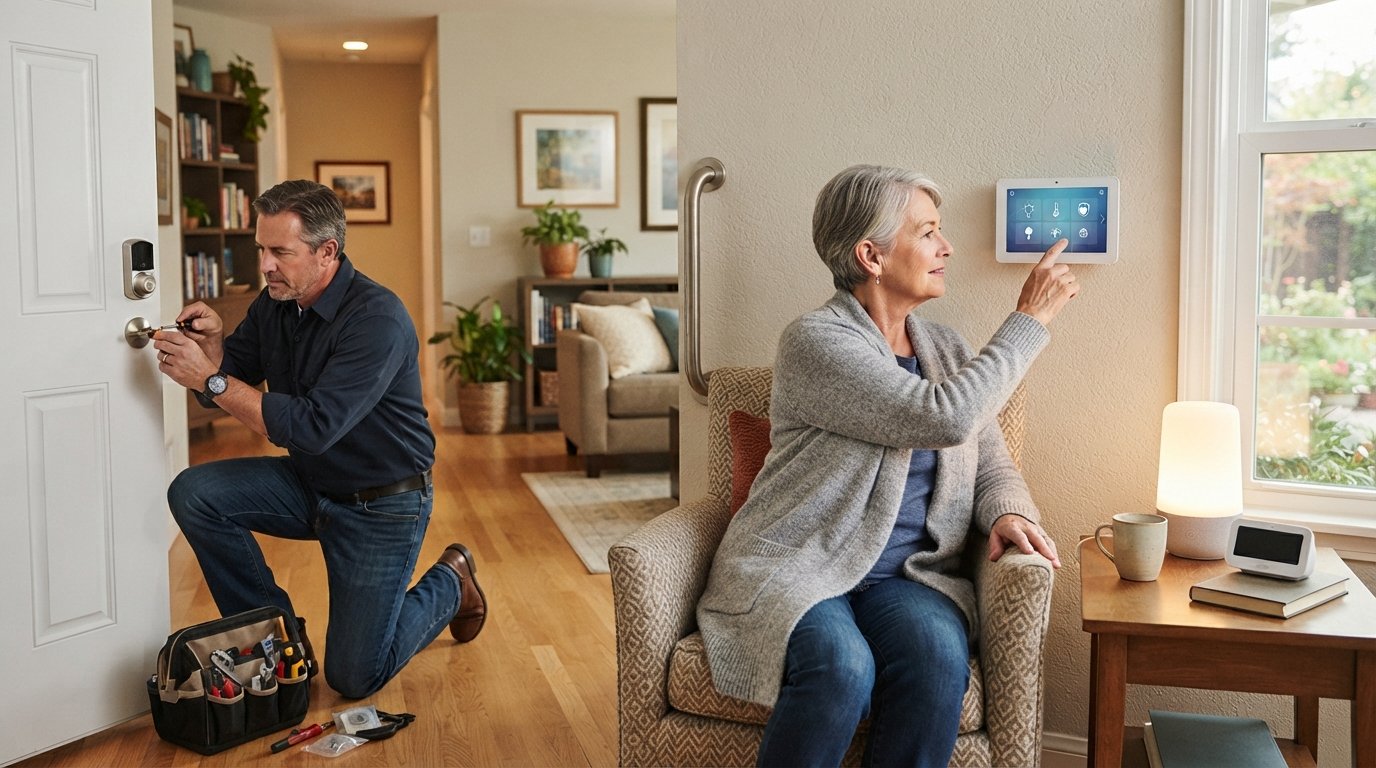
Smart Home Tech for Aging in Place and Accessibility
Smart home technology for aging in place and accessibility can extend independence and add resale value. Call (833)-365-8755 to plan your upgrades.

By Oliver Grant
Learn more about Smart Home Installation or Repair for guides, costs, and what to expect.
Compare Smart Home Installation or Repair Pros Near You

Enter your ZIP code to compare top-rated local professionals and request free quotes.
Most homeowners plan for retirement by saving money, not by rewiring their houses. Yet the ability to stay in your own home safely, comfortably, and independently as you age depends less on your bank balance and more on how well your living space adapts to changing needs. Smart home technology for aging in place and accessibility has moved far beyond novelty gadgets: it now includes voice-controlled lighting, automatic door locks, fall-detection sensors, and medication reminders that can genuinely extend the number of years you can live at home. The challenge is separating upgrades that add lasting value and daily convenience from expensive, highly personal installations that may not appeal to future buyers. This guide walks through the devices that matter, the costs you can expect, when to call a professional, and how to balance present-day comfort with long-term resale value.
Why Smart Home Technology Matters for Aging in Place
Aging in place means remaining in your own home as you grow older, rather than moving to an assisted living facility or a relative's house. Surveys consistently show that the vast majority of older adults want to stay put, but the physical layout of a typical suburban home often works against that goal. Stairs become hazards, door handles become difficult to grip, and lighting that was adequate at age 40 may feel dim at 70. Smart home technology addresses many of these friction points without requiring a full remodel.
The financial case is equally compelling. The cost of assisted living or a nursing home can exceed $5,000 per month in many U.S. markets, while a few thousand dollars invested in accessibility technology can delay that transition by years. For homeowners planning to sell eventually, certain upgrades also appeal to a growing demographic of buyers who are themselves thinking about aging in place or caring for older relatives. According to aging in place home modifications that boost home value, the key is prioritizing changes that are broadly useful rather than narrowly medical.
The technology landscape has matured rapidly. Ten years ago, home automation was a luxury hobbyist pursuit. Today, mainstream platforms like Amazon Alexa, Google Home, and Apple HomeKit support hundreds of devices at accessible price points, and professional installers are increasingly familiar with accessibility-focused setups. That means homeowners can start small, test what works, and scale up over time.
Core Smart Devices That Support Accessibility
The most effective accessibility technology tends to be invisible in daily use: it removes friction rather than calling attention to itself. Voice assistants are the clearest example. A simple voice command can turn on lights, adjust the thermostat, lock doors, or call a family member, which is transformative for anyone with limited mobility or dexterity. Smart speakers cost as little as $30 to $50, and they serve as the hub for many other devices.
Smart locks are another high-impact upgrade. They eliminate the need to fumble with keys, allow family members or caregivers to enter with temporary codes, and can be checked remotely to confirm a door is locked. Smart lighting goes beyond convenience: automated schedules and motion-triggered lights reduce the risk of falls during nighttime trips to the bathroom or kitchen. Sensors round out the foundation, detecting motion, door openings, water leaks, and even falls.
Here are the device categories that deliver the most consistent accessibility benefits:
- Voice assistants and smart speakers: hands-free control of lights, thermostats, locks, and emergency calls.
- Smart locks and doorbell cameras: keyless entry, remote monitoring, and visitor verification without opening the door.
- Smart lighting and plugs: scheduled, motion-activated, or voice-controlled operation to prevent falls and reduce strain.
- Motion, door, and fall sensors: alerts to caregivers or family members when something unusual happens.
- Smart thermostats and water-leak detectors: comfort, energy savings, and early warning of costly damage.
Each of these categories has entry-level options under $100 and premium options that integrate more deeply with security or medical alert systems. The right choice depends on the specific needs of the resident, not on buying the most expensive model available.
Which Upgrades Appeal to Future Buyers and Which Are Personal
Not every accessibility upgrade translates into resale value. Broadly useful technology, such as smart thermostats, video doorbells, and smart lighting, tends to appeal to a wide range of buyers because it improves convenience and energy efficiency for anyone. These are the upgrades real estate agents often highlight in listings, and they can modestly increase perceived value or speed up a sale.
Highly personal or medical-adjacent installations are a different story. Stairlifts, ceiling track hoists, and specialized medical alert systems with monitoring subscriptions may be essential for the current resident but can be a turnoff to buyers who see them as costly to remove or a reminder of decline. Walk-in tubs fall into a gray area: some buyers appreciate them, while others view them as a niche feature. The general rule is that anything permanently attached, expensive to remove, or visibly medical should be evaluated carefully before installation if a sale is likely within a few years.
Smart home technology for aging in place and accessibility sits mostly in the favorable category because devices are typically removable and replaceable. A smart lock can be swapped for a traditional deadbolt in minutes. A voice assistant can be unplugged. This modularity means homeowners can invest in accessibility now without locking in a design that future buyers might dislike. The exception is any device that requires significant wiring or structural modification, which is where installation costs and resale considerations intersect.
Installation Costs and When to Hire a Professional
Budgeting for smart accessibility upgrades is more predictable than most home improvement projects because the devices themselves are relatively inexpensive. The variable is installation, especially when electrical work or networking improvements are required. A smart speaker or smart plug is a plug-and-play purchase. A smart light switch that replaces a traditional switch usually requires basic electrical knowledge and about 15 to 30 minutes per switch. Hardwired sensors, new outlets, or whole-home networking setups are a different level of complexity.
As a rough guide, homeowners can expect the following cost ranges for common accessibility-focused smart home projects:
- Smart speaker or voice assistant hub: $30 to $150 per device, no installation cost.
- Smart lock installation: $150 to $350 per door including hardware, or $75 to $150 for professional installation alone.
- Smart lighting (bulbs or plugs): $20 to $60 per bulb or plug, self-installed.
- Smart light switch replacement: $150 to $300 per switch installed by an electrician, depending on wiring.
- Video doorbell and camera setup: $100 to $300 for hardware, plus $100 to $250 for professional installation if hardwiring is needed.
- Motion and fall sensors with caregiver alerts: $50 to $200 per sensor, plus optional monthly monitoring fees.
A licensed electrician is advisable whenever a project involves new wiring, replacing switches in older homes with uncertain wiring, or installing devices that draw significant power. If you are planning a broader renovation that includes electrical updates, it makes sense to bundle smart accessibility wiring with the larger project to save on labor. Sites like HomeRemodelingsContractors can help homeowners plan affordable improvement projects and connect with experienced local contractors, which is useful when you want multiple estimates for electrical or installation work.
For most homeowners, the practical approach is to self-install the plug-and-play devices and hire a professional only for hardwired work. That keeps costs low while ensuring safety and code compliance where it matters.
Balancing Convenience Now Against Resale Value Later
The smartest strategy for smart home technology for aging in place and accessibility is to favor upgrades that serve both goals simultaneously. A video doorbell helps a resident see who is at the door without rushing to answer, and it also appeals to buyers concerned about security. A smart thermostat lowers energy bills for the current owner and signals efficiency to future ones. Voice-controlled lighting is a genuine accessibility aid and a modern convenience that most buyers understand.
Homeowners who expect to sell within a few years should be cautious about devices that require subscriptions or proprietary hubs. A buyer may be unwilling to inherit a monitoring contract, and a system that only works with one brand can feel like a liability. Open-standard devices that work with multiple platforms are safer investments. It also helps to keep documentation: manuals, account credentials, and a simple diagram of how devices connect make the system easier to hand off.
For those planning to stay long term, the calculus shifts toward personal benefit. If a fall-detection sensor or medication reminder system improves daily safety, the resale question matters less. The ideal approach is a phased installation: start with low-cost, high-impact devices like voice assistants and smart plugs, add smart locks and lighting as budget allows, and reserve hardwired or medical-adjacent systems for when the need is clear. This keeps spending proportional to benefit and avoids over-investing in technology that may be obsolete or unwanted later.
Practical Steps to Start Your Smart Accessibility Upgrade
Beginning a smart home accessibility project does not require a large budget or a technical background. The most successful projects start with a walkthrough of the home to identify friction points: dark hallways, difficult door locks, stairs without lighting, or a bathroom that is hard to navigate at night. From there, match devices to the specific problems rather than buying technology for its own sake.
A simple sequence works well for most homeowners. First, install a voice assistant in the most-used room to test comfort with voice control. Second, add smart plugs or bulbs to automate lighting in hallways and bathrooms. Third, upgrade door locks and add a video doorbell for security and convenience. Fourth, add sensors for motion, water leaks, or falls as needs become clearer. Finally, consult a licensed electrician for any hardwired work or broader electrical upgrades.
Throughout the process, keep receipts, manuals, and account information organized. If you plan to sell, you will want to demonstrate that the system is functional and transferable. If you plan to stay, you will want a clear record for maintenance and future expansion. Either way, the goal is the same: a home that adapts to you, rather than one you have to adapt to.
Smart home technology for aging in place and accessibility is no longer a niche concern for a small group of homeowners. It is a practical, increasingly affordable way to extend independence, reduce fall risk, and add modern convenience that future buyers will recognize. Start with the devices that solve today's problems, hire professionals for the work that requires expertise, and choose open, removable technology that keeps your options open. With that approach, the investment pays off in safety, comfort, and long-term peace of mind.