
Repair or Replace Your Water Heater: How to Decide
Repair or replace your water heater how to decide comes down to age, failure type, and repair cost versus a new unit. Here is the framework to choose right.

By Liam Weston
Learn more about Water Heater Installation or Replacement for guides, costs, and what to expect.
Compare Water Heater Installation or Replacement Pros Near You

Enter your ZIP code to compare top-rated local professionals and request free quotes.
Your water heater is one of those appliances you never think about until it fails. And when it does, the decision hits fast: do you call a technician for a repair, or do you start shopping for a new unit? That choice can swing your budget by hundreds or even thousands of dollars, and getting it wrong can mean repeating the same problem six months later. The good news is that the decision follows a fairly predictable logic once you know which factors matter most. This guide walks through the age of your unit, the type of failure, repair costs, energy efficiency, and long-term value so you can make a confident call instead of a panicked one.
Start With Age and Warranty Status
Age is the single most useful data point you have. A conventional tank water heater typically lasts 8 to 12 years, while a tankless unit can run 20 years or more with proper maintenance. If your tank unit is already past the 10-year mark, repairs start to look like throwing money at a machine that is living on borrowed time. Even a successful fix does not reset the clock on the tank itself, and the next failure could arrive within months.
Warranty status matters just as much. Most tanks carry a 6-year or 12-year warranty, and tankless models often carry 10 to 15 years on the heat exchanger. If your unit is still under warranty, the manufacturer may cover the failed part, which tilts the math strongly toward repair. If the warranty expired years ago, every repair comes straight out of your pocket with no safety net.
A quick way to frame it: a 6-year-old unit with a covered part failure is almost always a repair candidate. A 13-year-old unit with a leaking tank is almost always a replacement. The gray zone sits in the middle, and that is where the next few sections do the heavy lifting.
Identify What Actually Failed
Not all water heater problems are equal. Some failures are cheap, isolated, and easy to fix. Others signal that the tank or heat exchanger is compromised, which is a fundamentally different situation. Before you accept any quote, make sure you understand which category your problem falls into.
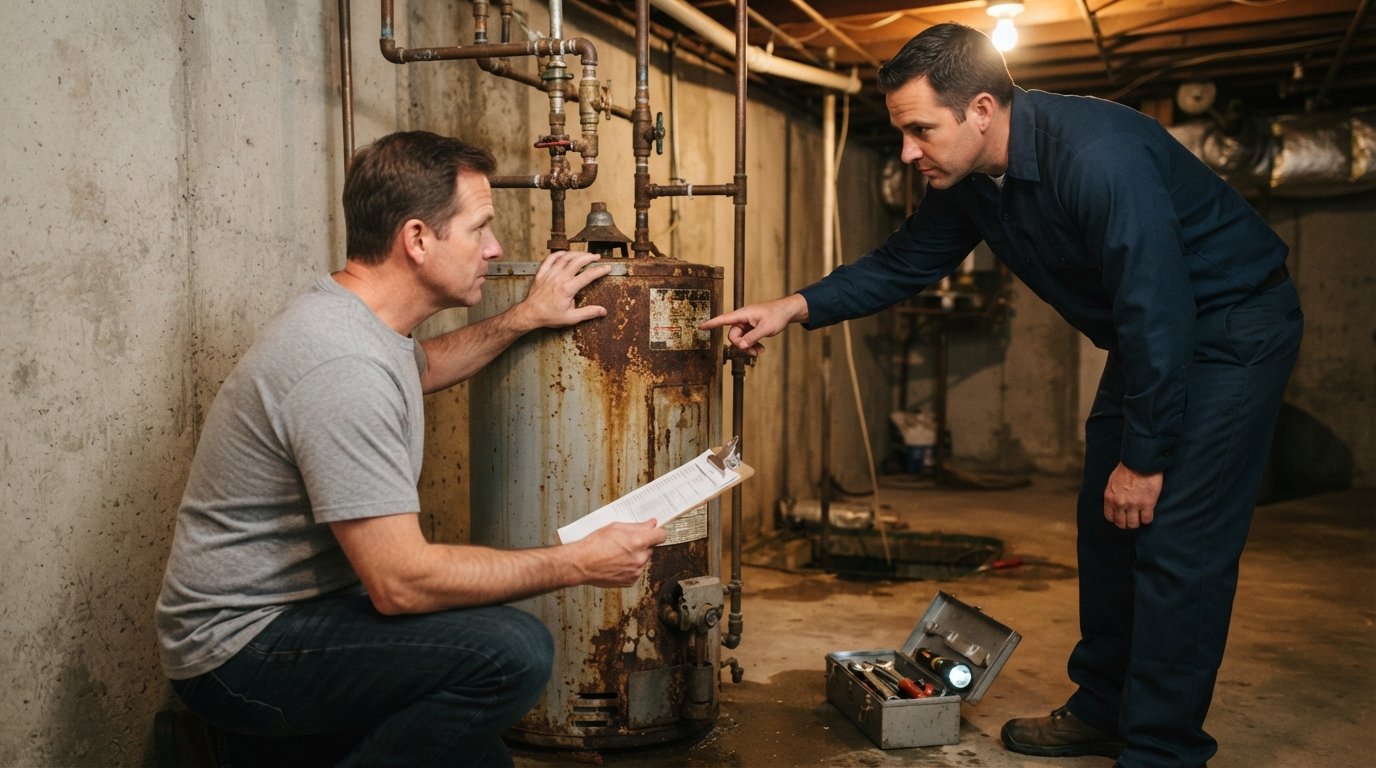
Common repairable issues include a failed heating element, a broken thermostat, a worn dip tube, a faulty thermocouple, a bad pilot light assembly, a leaking pressure relief valve, or a clogged burner. These are component-level failures, and on a younger unit they are worth fixing without much debate. Common replacement-level issues include a leaking tank, heavy corrosion or rust streaks on the tank body, sediment buildup so severe that the tank rumbles and overheats, and a cracked heat exchanger on a tankless unit.
Here is a simple way to sort the diagnosis before you spend a dollar:
- No hot water at all, but the tank is dry and quiet: likely a heating element, thermostat, or pilot issue, and usually repairable.
- Water pooling under the tank or rust streaks down the side: the tank itself is failing, and replacement is the realistic path.
- Inconsistent temperatures or a rumbling sound: sediment buildup, which may be flushable if caught early.
- Visible corrosion on fittings or the tank top: age-related deterioration that rarely stays contained.
If you are unsure which bucket your unit falls into, a licensed plumber or HVAC technician can diagnose it, often for a modest service call fee. That diagnosis is money well spent because it prevents you from replacing a unit that had a $180 thermocouple problem, or repairing a tank that is about to flood your garage.
Run the 50 Percent Rule on Repair Costs
The most widely used rule of thumb in the trades is the 50 percent rule: if a repair costs more than half the price of a new unit, replace it. That sounds simple, but the real calculation includes more than the sticker price of the repair.
Add up the repair quote, the age of the unit relative to its expected lifespan, and the likelihood of a second failure in the next year or two. A $600 repair on a 10-year-old tank that costs $1,200 to replace sits right at the threshold, and at that point age and condition should break the tie toward replacement. A $250 repair on a 5-year-old unit is an easy yes for repair.
It also helps to think about what else the money could buy. If you are already facing a $700 repair, the incremental cost of a new, more efficient unit may be smaller than you expect, especially when you factor in lower utility bills and a fresh warranty. Homeowners who plan ahead often find that bundling the water heater replacement with other plumbing or HVAC work reduces labor costs, and platforms that connect you with experienced local remodeling contractors can help you compare quotes and time the project efficiently.
One more cost most people forget: water damage. A failed tank can dump 40 to 80 gallons into your home within minutes. If your unit sits in a finished basement, near hardwood floors, or above a ceiling, the risk of a catastrophic leak should push you toward replacement sooner than the repair math alone suggests.
Weigh Efficiency, Capacity, and Fuel Type
Efficiency standards have tightened considerably over the past decade, and a new water heater is meaningfully more efficient than one built 12 or 15 years ago. If your current unit has an energy factor around 0.55 and a new model runs 0.65 or higher, the difference shows up on every utility bill. Over a 10-year horizon, that gap can offset a meaningful chunk of the purchase price.
Capacity is the second factor. If your household has grown, if you have added a bathroom, or if you constantly run out of hot water during morning showers, repairing the old unit just locks in an undersized system. Replacing it is the only way to solve a capacity problem, and it is worth sizing the new unit correctly rather than guessing.
Fuel type also shapes the decision. Gas units have more components that can fail (thermocouple, gas valve, burner assembly), while electric units are simpler but rely on elements and thermostats that corrode over time. Tankless units cost more upfront but last longer and never run out of hot water, so if you are replacing anyway, it is a reasonable moment to consider switching. If you are unsure whether your home is set up for a switch, a qualified pro can assess venting, gas line capacity, and electrical requirements in a single visit.
Factor In Installation, Code, and Permits
Replacement is not just the price of the box. Installation can add several hundred dollars, and older homes often need upgrades to meet current code: a new expansion tank, a drip pan and drain line, updated venting, or a permit and inspection. Those line items can push a straightforward swap into a larger project, and they are exactly the costs homeowners forget when comparing a repair quote to a replacement quote.
Repairs, by contrast, usually avoid permit requirements because you are not altering the system. That is a real advantage for a young unit with a simple component failure. But if the repair involves moving the unit, changing the venting, or modifying gas or electrical connections, the permit math changes and the gap between repair and replace narrows quickly.
It is also worth checking local rules before you commit. Some jurisdictions require a permit for any water heater replacement, and skipping it can complicate a future home sale. A licensed contractor will handle the paperwork, which is one more reason to work with a vetted professional rather than a handyman who offers to do it off the books.
Use a Simple Decision Framework
When you are standing in a puddle at 7 a.m., you do not want a 20-page report. You want a clear path. This framework condenses everything above into a decision you can make in a few minutes, and it works whether you are dealing with a tank or a tankless unit.
- Check the age. Under 8 years old, lean repair. Over 12 years old, lean replace. Between 8 and 12, keep reading.
- Identify the failure. Component-level issues favor repair. Tank leaks, corrosion, and cracked heat exchangers favor replacement.
- Apply the 50 percent rule. If the repair quote exceeds half the cost of a new installed unit, replace.
- Consider risk and efficiency. Finished living space below the unit, rising utility bills, or a growing household all push toward replacement.
- Get two or three quotes. A second opinion sometimes reveals that a repair is simpler and cheaper than the first technician suggested, or that replacement is more urgent than you thought.
If you land on replacement, do not rush the purchase. Compare tank versus tankless, confirm the size your household actually needs, and ask about installation costs, permits, and warranty terms in writing. If you land on repair, ask the technician what else is likely to fail in the next year so you are not surprised twice. Either way, get the diagnosis in writing and keep the paperwork, because it is useful when you sell the home or file an insurance claim.
For homeowners planning a broader project, the water heater decision rarely stands alone. If you are also considering a bathroom refresh, a basement finish, or an HVAC upgrade, it often makes sense to coordinate the work so you pay for one mobilization instead of three. That is exactly the kind of planning BuySellRemodel is built around: free estimates, a curated network of local pros, and a process that lets you compare options before you commit. You can request quotes for a water heater replacement alongside any other project on your list and see how the numbers stack up side by side.
The bottom line is that repair or replace your water heater how to decide comes down to three questions: how old is it, what failed, and how much does the fix cost relative to a new unit. Answer those honestly, factor in the risk of water damage and the long-term savings from efficiency, and the right choice usually becomes obvious. When in doubt, get a professional diagnosis and a couple of quotes. A few hundred dollars of diligence now can save you thousands later, whether you repair the unit you have or upgrade to one that will serve your home for the next decade.