
Foundation Repair Cost and Warning Signs for Homeowners
Foundation repair cost and warning signs for homeowners explained, plus how to avoid surprise bills. Call (833)-365-8755 for a free local estimate.

By Liam Weston
Learn more about Foundation Repair for guides, costs, and what to expect.
Compare Foundation Repair Pros Near You

Enter your ZIP code to compare top-rated local professionals and request free quotes.
A crack in the drywall above a door frame. A floor that slopes just enough to notice. A basement wall that seems to bow inward after a wet spring. These small clues often point to one of the most stressful discoveries a homeowner can make: a foundation problem. Because the foundation carries the entire weight of the house, even minor movement can ripple through floors, walls, windows, and doors. The good news is that most foundation issues are fixable, and catching them early usually means paying hundreds instead of tens of thousands. The challenge is knowing what you are looking at, what a fair price looks like, and when to call a professional before the damage spreads.
This guide walks through the warning signs that matter, the real-world costs behind common repair methods, and the practical steps that protect your budget and your home's value. If you would rather skip the guesswork and get a written quote from a vetted local expert, you can start with a free estimate and compare options side by side.
Why Foundation Problems Happen in the First Place
Foundations rarely fail overnight. Most damage builds slowly over years as soil, water, and time work against the concrete, block, or pier system holding your home in place. Understanding the cause matters because the repair method, and the price, depends on what is actually happening underground.
Expansive clay soil is one of the most common culprits. When it absorbs water, it swells and pushes against foundation walls. When it dries out during a hot summer, it shrinks and leaves voids that the foundation settles into. That constant cycle of swelling and shrinking creates the movement that cracks slabs, bows walls, and throws doors out of alignment. Poor drainage makes everything worse. Gutters that dump water next to the house, grading that slopes toward the foundation, and downspouts that discharge too close to the wall all feed the soil directly around your home.
Tree roots pull moisture from the soil beneath a foundation, causing localized settling. Plumbing leaks under a slab slowly erode or soften the supporting soil. In colder regions, freeze and thaw cycles lift and drop the ground repeatedly. Older homes may simply have been built with materials and methods that no longer meet modern standards. In every case, the underlying issue is almost always water, soil movement, or both, which is why a good contractor will look at drainage before quoting a repair.
Warning Signs Every Homeowner Should Recognize
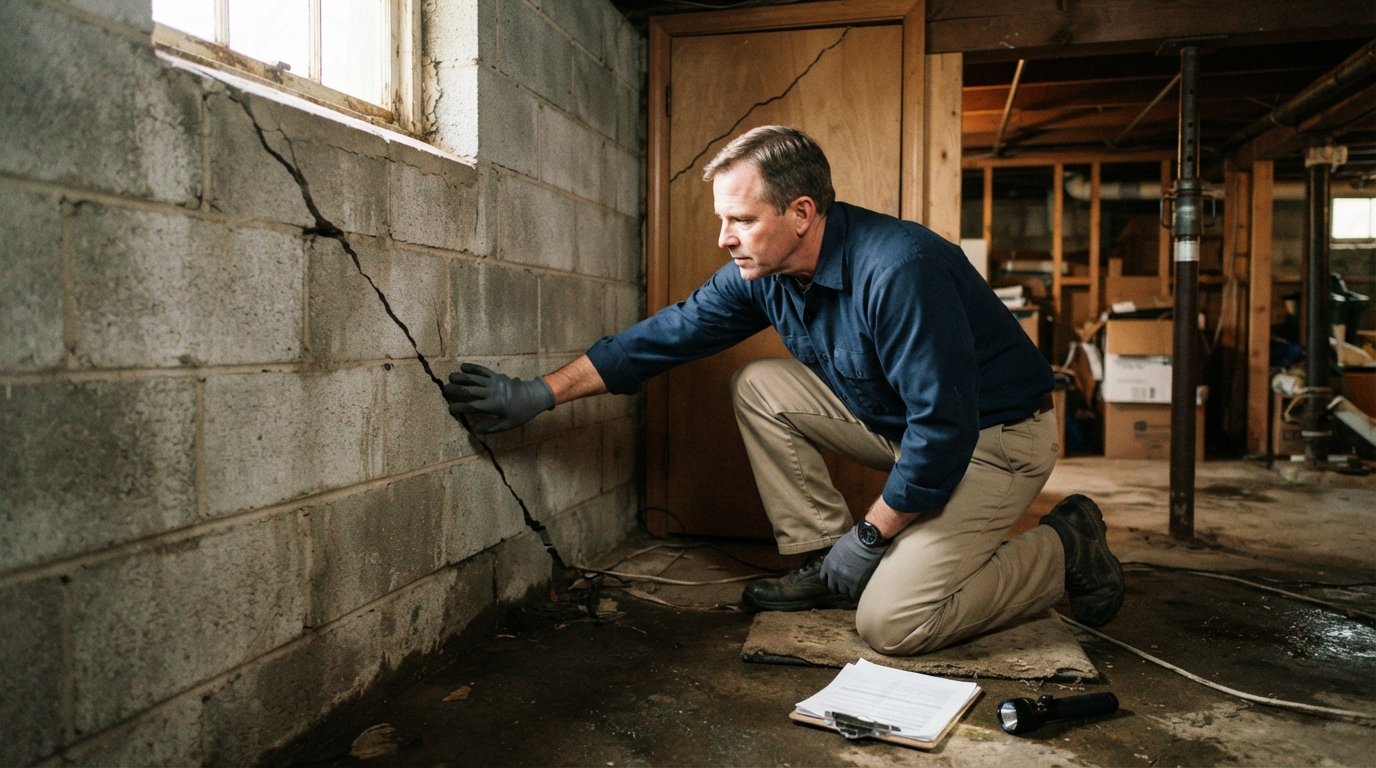
The tricky part of foundation damage is that the earliest symptoms look like ordinary house settling. Every home moves a little. The difference is severity, pattern, and whether the problem is getting worse. A single hairline crack in a garage slab is usually cosmetic. A stair-step crack running up a block wall, or a crack that widens over a few months, deserves a professional look.
Pay attention to how the symptoms cluster. Foundation trouble rarely shows up as one isolated issue. It tends to produce a pattern of related problems across the same area of the house. Here are the signals that should prompt a call:
- Stair-step cracks in brick or block walls, especially those wider than a quarter inch
- Doors and windows that stick, jam, or no longer latch properly
- Floors that slope, feel bouncy, or sag noticeably in one area
- Horizontal cracks or bowing in basement or crawl space walls
- Gaps around exterior windows and doors, or cracks where the wall meets the ceiling
Interior clues matter just as much. Cracks that run diagonally from the corner of a door or window frame, known as stair-step or diagonal cracks, often trace back to differential settlement. Uneven grout lines in tile floors, cabinets that pull away from the wall, and chimneys that lean away from the house are all red flags. Musty odors or standing water in a crawl space point to moisture problems that can undermine the foundation over time.
It also helps to know what is normal. Hairline cracks under a quarter inch, minor cracks in a garage floor, and small shrinkage cracks in new concrete are typically not structural emergencies. The concern rises when cracks are wider than a quarter inch, when they are horizontal rather than vertical, when they appear suddenly, or when they come with sticking doors and sloping floors. When in doubt, document the crack with a photo, note the date, and measure it again in a month. Growth is the clearest signal that you need an expert opinion.
What Foundation Repair Actually Costs
Foundation repair pricing varies widely because the scope ranges from sealing a few cracks to installing a full system of piers around the perimeter of a home. Geography, soil conditions, foundation type, and accessibility all move the number. The figures below reflect typical U.S. ranges for common methods, but treat them as a starting point for budgeting rather than a fixed quote.
For a more detailed breakdown of methods and pricing factors, our guide on foundation repair cost and common issues walks through the same categories with additional context on when each approach makes sense.
Crack Sealing and Minor Repairs
Small, non-structural cracks can often be injected with epoxy or polyurethane foam, or sealed with hydraulic cement. This is the least expensive category of work, typically running a few hundred dollars per crack. If the cause is a plumbing leak or a grading issue, the repair cost may include redirecting water, which is money well spent because it prevents the crack from returning.
Slabjacking and Mudjacking
When a concrete slab has settled but is otherwise sound, contractors can pump a grout or foam mixture underneath to lift it back into place. Slabjacking with a cement-based slurry is the older, cheaper method. Polyurethane foam injection is cleaner, lighter, and often more precise, but it costs more. Homeowners commonly pay somewhere between a few hundred and a few thousand dollars depending on the number of slabs and the amount of lift required.
Pier and Beam Systems
For homes with crawl spaces, pier and beam foundations can be leveled by adding, adjusting, or replacing supports. This work is more invasive than slabjacking and typically costs more per pier. A single pier replacement might run several hundred dollars, while a full leveling project across an entire home can reach five figures.
Steel and Helical Piers
When a slab or perimeter foundation has settled significantly, steel push piers or helical piers are driven or screwed into stable soil and used to lift the home. This is the most durable solution for serious settlement, and it is also the most expensive. Prices are usually quoted per pier, and a typical project may require several piers on one or more sides of the house. Expect the total to land in the thousands to low tens of thousands, with the exact figure depending on depth, soil, and the number of piers.
Carbon Fiber and Wall Anchors
Bowing basement walls are often stabilized with carbon fiber straps, steel I-beams, or wall anchors. Carbon fiber is the least invasive and generally the most affordable of the three. Wall anchors and I-beams cost more but offer greater holding power for severe bowing. A single wall can cost anywhere from a few thousand dollars upward, and multiple walls multiply the total quickly.
Two rules of thumb help keep expectations realistic. First, the deeper the problem and the more of the house it affects, the higher the price. Second, the cost of doing nothing is usually higher than the cost of a timely repair, because foundation movement rarely reverses on its own. For homeowners who want to compare bids without pressure, requesting a free estimate from a local contractor is the fastest way to see real numbers for your specific situation.
What Drives the Price Up or Down
Two homeowners can receive quotes for the same symptom that differ by thousands of dollars, and both can be legitimate. The difference usually comes down to a handful of variables. Knowing them helps you read a quote critically instead of assuming the cheapest bid is the best one.
Soil type is a major factor. Expansive clay requires deeper piers and more robust solutions than sandy or rocky soil. Accessibility matters too: a foundation wall that is easy to reach from the exterior is cheaper to repair than one blocked by a finished basement, a deck, or mature landscaping. The number of piers, anchors, or injection points drives the total almost linearly, so a problem confined to one corner is far less expensive than one affecting three sides of the house.
Permits, engineering reports, and warranties also affect the bottom line. Some jurisdictions require a structural engineer to sign off on certain repairs, which adds a fee but also adds confidence. A transferable warranty is worth paying a little more for, especially if you plan to sell. Finally, urgency plays a role. A homeowner who repairs a settling foundation in the early stages often spends a fraction of what a homeowner spends after the problem has cracked tile, warped floors, and damaged drywall throughout the house. If you are weighing repair against other projects, it helps to work with a platform built for homeowners who want clear guidance on projects, costs, and timelines, like HomeRemodelingsContractors, so you can plan the work without overextending your budget.
How to Vet a Foundation Repair Contractor
Foundation repair attracts both skilled specialists and high-pressure sales operations, so the vetting process matters as much as the repair method. A qualified contractor will inspect the entire foundation, not just the visible crack, and will explain the cause before recommending a fix. If a salesperson jumps straight to a price without diagnosing the source of the movement, that is a warning sign in itself.
Start by getting at least three written estimates. Ask each contractor what repair method they recommend and why, whether the work is covered by a warranty and for how long, and whether the warranty is transferable to a future buyer. Request proof of licensing and insurance, and ask for references from projects completed at least a year ago, since foundation repairs need time to prove themselves. Be cautious of any quote that requires a large deposit up front or that pressures you to sign the same day.
It also helps to ask whether the contractor will address drainage and grading alongside the structural repair. A pier system that lifts a settled foundation is only half the solution if water continues to pool against the house. The best contractors think in terms of prevention, not just repair, and they are usually happy to explain their reasoning in plain language. If you want a shortcut, a curated network of vetted local contractors can remove much of the risk from this step, because the professionals in the network have already been screened for licensing, insurance, and track record.
Prevention: Protecting Your Foundation Before Problems Start
The most affordable foundation repair is the one you never need. A few maintenance habits dramatically reduce the odds of expensive movement. Keep gutters clean and make sure downspouts discharge several feet away from the foundation. Check that the soil around the house slopes away from the walls, and add fill if it has settled over time. In dry climates, a soaker hose run at the perimeter during extended droughts can help keep clay soil from shrinking too aggressively.
Manage vegetation carefully. Large trees should be planted well away from the foundation, and root barriers can help where mature trees already exist. Fix plumbing leaks promptly, since even a slow drip under a slab can erode supporting soil over years. Finally, walk the perimeter of your home twice a year, in spring and fall, and look for new cracks, gaps, or changes in grade. Photograph anything suspicious and compare over time. A ten-minute inspection twice a year is one of the highest-return maintenance tasks a homeowner can perform.
If you do find warning signs, resist the urge to panic or to ignore them. Get a professional assessment, collect a few quotes, and prioritize the repair before smaller symptoms turn into structural damage. Homeowners who act early usually spend less, sell more easily, and sleep better. When you are ready to move forward, the right local pro is only a free estimate away.