
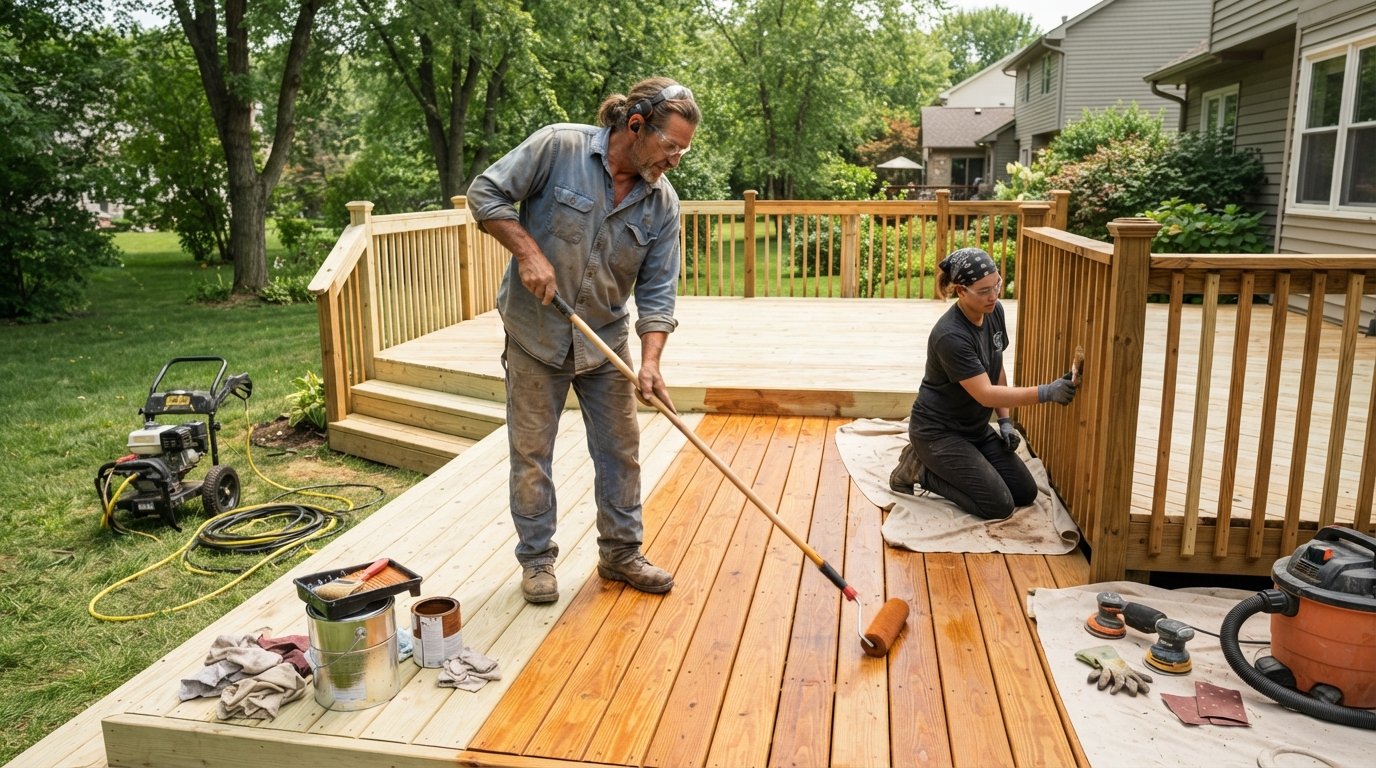
Deck Staining Cost and Best Time of Year to Protect Your Deck
Deck staining cost and best time of year explained, from pricing by deck size to ideal weather windows. Call (833)-365-8755 for a free local estimate.

By Elena Ellis
Learn more about Deck Staining and Sealing for guides, costs, and what to expect.
Compare Deck Staining and Sealing Pros Near You

Enter your ZIP code to compare top-rated local professionals and request free quotes.
Your deck takes a beating from sun, rain, and foot traffic, and staining is the single most effective way to protect that investment. But homeowners often get stuck on two questions: what will it actually cost, and when should the work happen? Get either wrong and you risk peeling finish, wasted money, or a deck that fails years before it should. This guide breaks down real-world pricing, the ideal weather window, and the structural checks you need to make before a brush ever touches the wood.
What Deck Staining Really Costs in 2026
Deck staining cost and best time of year are tightly connected: the price you pay depends partly on when you book, because peak-season scheduling and weather delays can push labor rates up. Nationally, professional deck staining runs from about $2 to $4 per square foot for a basic clean-and-stain job, with most homeowners paying between $500 and $1,500 total. A small 200-square-foot deck might land near $550, while a 500-square-foot deck with railings, stairs, and multiple levels can exceed $2,000.
Several factors move that number up or down. The surface area matters most, but so does the condition of the wood, the type of stain, and whether repairs are needed. Here is how the main cost drivers break down:
- Deck size: Expect roughly $2 to $4 per square foot for labor and material on a standard rectangular deck.
- Material: Pressure-treated pine is cheapest to stain; cedar and hardwood cost more because they need specialized products and gentler prep.
- Stain type: Transparent and semi-transparent stains cost less than solid-color stains, which require more product and more careful application.
- Prep work: Power washing, sanding, and brightening add $150 to $400 depending on condition.
- Repairs: Replacing rotten boards or tightening railings adds $100 to $500 or more before staining can begin.
Material costs alone are modest: a gallon of quality stain covers 150 to 300 square feet and runs $25 to $60. The real expense is labor, which is why deck size and complexity drive the final bill. Decks with lots of spindles, built-in benches, or tight corners take longer and cost more per square foot. If you are weighing whether to handle the work yourself, our guide on DIY vs professional deck staining cost and results walks through the real trade-offs in time, tools, and finish quality.
Best Time of Year to Stain a Deck
The best time of year to stain a deck is late spring or early fall, when temperatures stay between 50 and 80 degrees Fahrenheit and humidity is moderate. Those conditions let the stain penetrate and cure properly. Too hot and the stain dries before it soaks in; too cold and it never cures correctly, leaving a tacky or peeling surface.
Season-by-season, here is what to expect. Spring works well once the last frost has passed and the wood has dried out from winter. Fall is often ideal because temperatures are stable, humidity is lower, and you avoid the intense summer sun that can flash-dry stains. Summer is doable but requires early-morning application to beat the heat. Winter is generally off-limits in most climates because cold nights prevent proper curing, though mild southern regions may still have a workable window.
Weather conditions on the day of application matter as much as the season. You want two to three days of dry weather with no rain in the forecast, since rain within 24 hours can ruin a fresh coat. Avoid applying stain when the deck is in direct, blazing sun; the surface should be dry but not hot to the touch. Windy days are also a problem because they speed drying and blow debris onto wet stain.
Timing also interacts with your deck's maintenance cycle. New pressure-treated wood needs to weather for three to six months before staining so it can absorb the product. Previously stained decks should be re-coated every two to three years, and the best time to do that is when the old finish starts looking worn but before bare wood is exposed. Scheduling in early fall gives you protection before winter moisture sets in.
DIY vs Professional Staining: Cost, Time, and Results
Many homeowners consider staining the deck themselves to save money, and the savings can be real: DIY typically costs $200 to $600 in materials and equipment for an average deck, versus $800 to $1,500 for professional work. But the comparison is not just about the sticker price. Professional crews bring commercial-grade cleaners, proper sprayers, and the experience to avoid common mistakes like over-applying stain or leaving lap marks.
DIY makes sense if you have a simple, single-level deck, the time to do proper prep, and some comfort with power tools. It is a two-to-three-day project when done right: one day to clean and prep, one day to stain, and another day for a second coat if needed. Professional work usually takes one day for the same deck and includes cleanup.
Where DIY goes wrong is in the prep. Skipping power washing, staining over damp wood, or applying in direct sun can lead to peeling within a year, which wipes out the savings. Professionals also spot rot and structural problems that homeowners miss, and they carry insurance if something goes wrong. If your deck is large, multi-level, or shows signs of damage, hiring a pro is usually the better financial decision in the long run.
Spotting Rot and Structural Issues Before You Stain
Staining over damaged wood is a waste of money. Before any stain goes down, walk the deck and check for these warning signs: soft or spongy boards, visible cracks wider than a quarter inch, loose railings, rusted fasteners, and dark or discolored patches that stay damp. Pay special attention to where the deck meets the house, around posts, and at stair stringers, since those areas trap moisture.
Test suspect boards with a screwdriver or awl. If the tool sinks in easily or pulls out soft, crumbly wood, that board needs replacement. Check underneath the deck too, looking for sagging joists, water stains, or insect damage. A deck that moves or feels unstable when you walk on it should be inspected by a professional before any cosmetic work begins.
Minor repairs, like replacing a few boards or tightening loose railings, can often be handled during the same project as staining. Larger structural problems, such as rotted joists or failing ledger board connections, need to be fixed first. This is where a professional assessment pays off: a contractor can tell you whether you are looking at a simple stain job or a repair project. For homeowners planning multiple exterior projects, connecting with experienced local pros through HomeRemodelingsContractors can simplify the process and help you compare estimates before committing.
How to Budget for Deck Staining
A realistic budget covers more than the stain itself. Plan for cleaning supplies or power washing, any board replacements, stain and applicators, and optional extras like sealing or railing treatment. For a 300-square-foot deck in decent condition, a sensible DIY budget is $300 to $500, while professional work runs $800 to $1,200. Add 15 to 20 percent as a cushion for surprises like hidden rot or extra prep.
Getting multiple estimates is the simplest way to control costs. Three quotes give you a clear picture of the local market and help you spot outliers. Ask each contractor what prep is included, what stain brand they use, and whether repairs are priced separately. A detailed written estimate protects you from surprise charges later.
Finally, think about timing your project to save money. Late fall and early spring are often slower seasons for deck contractors, which can mean more competitive pricing and faster scheduling. Booking in advance also lets you lock in a weather window rather than scrambling when conditions are right.
Staining your deck is one of the highest-return maintenance tasks you can do, and getting the cost and timing right makes the difference between a finish that lasts three years and one that fails in twelve months. Check the wood, pick your season, compare estimates, and protect that outdoor space before the weather turns.