
Kitchen Countertop Durability and Cost: 2026 Guide
Compare kitchen countertop materials durability and cost comparison to find your best fit. Call (833)-365-8755 for free local estimates.

By Valerie Nguyen
Learn more about Kitchen Remodel for guides, costs, and what to expect.
Compare Kitchen Remodel Pros Near You

Enter your ZIP code to compare top-rated local professionals and request free quotes.
Choosing the right kitchen countertop feels like a high-stakes decision. You are picking a surface that must survive years of hot pans, sharp knives, spilled wine, and the occasional dropped glass, all while fitting a budget that already feels stretched. The wrong choice can mean scratches, stains, or cracks within a year. The right one can last decades. This guide breaks down kitchen countertop materials durability and cost comparison in plain numbers, so you can compare granite, quartz, laminate, butcher block, and solid surface without the sales pitch.
We will cover real-world durability (how each material handles heat, scratches, stains, and impact), realistic installed costs per square foot, maintenance demands, and lifespan. You will also see which options make sense for busy families, rental properties, and luxury kitchens. By the end, you will know exactly which countertop fits your lifestyle and your wallet. For a broader side-by-side look at how materials stack up across the board, see our detailed kitchen countertop materials comparison.
The Durability Factors That Actually Matter
Durability is not a single score. A countertop that resists scratches may etch from lemon juice. One that handles heat may chip at the edge. When comparing kitchen countertop materials durability and cost comparison, you need to weigh four separate performance categories.
- Heat resistance: Can you set a hot skillet down without a trivet?
- Scratch resistance: Will daily chopping and sliding plates dull the surface?
- Stain and etch resistance: Do wine, oil, or acidic foods leave permanent marks?
- Impact and chip resistance: What happens when a cast-iron pan slips?
Each material wins in some categories and loses in others. Natural stone like granite handles heat beautifully but can chip and needs periodic sealing. Quartz resists stains and scratches but can scorch under extreme heat. Laminate is affordable and easy to clean but can delaminate near a hot pot. Butcher block is gentle on knives but requires oiling and can stain.
Think about your cooking style. If you sear steaks and bake daily, heat resistance is non-negotiable. If you have young children who leave juice spills, stain resistance moves to the top. If you are a serious home chef with expensive knives, a softer surface like wood might save your blades. The point is simple: no single material is best at everything, so match the weaknesses to your tolerance.
Cost Comparison: What You Will Actually Pay
Installed cost is where most homeowners get surprised. The sticker price at a big-box store rarely includes fabrication, edge profiles, sink cutouts, and labor. A $30 per square foot slab can become $75 per square foot installed. Always ask for a fully installed quote.
Here is a realistic range for common materials in 2026, based on typical U.S. market rates:
- Laminate: $20 to $50 per square foot installed
- Butcher block: $35 to $75 per square foot installed
- Solid surface (e.g., Corian): $45 to $95 per square foot installed
- Quartz: $55 to $120 per square foot installed
- Granite: $50 to $150 per square foot installed
These ranges shift based on your region, edge details, and whether you choose a remnant or a full slab. A small kitchen of 30 square feet might cost $1,500 in laminate or $4,500 in quartz. A large kitchen of 60 square feet doubles those numbers quickly. Budget not just for the surface but for removal and disposal of the old countertop, which can add $200 to $500.
If you are planning a full kitchen remodel, countertops typically represent 5 to 10 percent of the total budget. Cabinets, appliances, and labor eat the rest. That means spending an extra $2,000 on quartz instead of laminate might be a small percentage of your overall project, but it still needs to fit your bottom line. For homeowners who want help comparing quotes and finding affordable local pros, HomeRemodelingsContractors connects you with experienced contractors who can provide free estimates and help you plan a budget-friendly upgrade.
Material-by-Material Breakdown
Laminate: The Budget Champion
Laminate countertops are made from a particleboard core covered with a decorative paper layer and a protective plastic top. Modern laminate looks far better than the shiny, fake-granite patterns of the 1990s. You can now find realistic stone and wood textures at a fraction of the cost.
Durability-wise, laminate is moderate. It resists stains and scratches reasonably well, but it can scorch if you place a hot pan directly on it. It can also swell if water seeps into seams around the sink. Lifespan is typically 10 to 15 years. Maintenance is easy: wipe with a damp cloth and mild cleaner. Avoid abrasive pads and always use a trivet.
Best for: rental properties, flip houses, budget-conscious homeowners, and anyone who plans to remodel again in a few years.
Butcher Block: Warm and Knife-Friendly
Butcher block is solid wood strips glued together, usually maple, oak, or walnut. It brings warmth and a natural look that stone cannot match. It is also gentle on knives, which is a big plus for serious cooks.
But durability requires effort. Wood scratches, dents, and stains. It needs oiling every one to three months and resealing annually. Water damage around the sink is a real risk if you do not seal edges properly. You can sand out scratches and re-oil, which extends its life indefinitely if you keep up with it. Expect 20 plus years with good care.
Best for: bakers, cooks who chop daily, and homeowners who love a farmhouse or transitional style and do not mind routine maintenance.
Solid Surface: Seamless and Repairable
Solid surface materials like Corian are acrylic-based and non-porous. They resist stains, mold, and bacteria, and they can be sanded and polished to remove scratches. Seams are nearly invisible, which makes them great for large islands.
Heat resistance is the weak spot. Hot pans can scorch or crack solid surface, so trivets are mandatory. It also scratches more easily than quartz. Lifespan is 15 to 20 years, and maintenance is low: just soap and water. If you damage it, a professional can usually repair it.
Best for: families who want a clean, seamless look and are willing to use trivets, and for bathrooms or laundry rooms where heat is less of a concern.
Quartz: The Low-Maintenance Favorite
Quartz countertops are engineered from about 90 to 95 percent ground quartz mixed with resin and pigments. They are non-porous, so they never need sealing. They resist stains, scratches, and bacteria better than most natural stone.
The main caution is heat. Quartz can scorch or discolor under a very hot pan, and the resin can degrade over time with repeated heat exposure. Always use a trivet. Impact resistance is good, but edges can chip if hit hard. Lifespan is 20 to 30 years. Maintenance is minimal: wipe with soap and water.
Best for: busy families, anyone who wants a no-fuss surface, and homeowners who prefer consistent color and pattern over natural variation.
Granite: Natural Stone with Timeless Appeal
Granite is a natural igneous rock, quarried in slabs and polished or honed. Each slab is unique, which is a major selling point for luxury kitchens. It handles heat extremely well, so you can set a hot pan down without worry.
However, granite is porous and needs sealing every one to two years to prevent stains. It can chip at the edges, and some stones are more prone to staining than others. It is also heavy, so cabinets may need reinforcement. Lifespan is 30 plus years. Maintenance is moderate: seal regularly and clean with a pH-neutral cleaner.
Best for: homeowners who want a one-of-a-kind surface, love natural stone, and do not mind annual sealing.
Comparing Lifespan and Long-Term Value
Cheap does not always mean better value. A $1,500 laminate countertop that lasts 12 years costs about $125 per year. A $4,500 quartz countertop that lasts 25 years costs about $180 per year. The quartz costs more upfront but delivers better performance, fewer repairs, and stronger resale appeal.
If you plan to sell your home within five years, laminate or butcher block can be smart choices because they look good without a huge investment. If you plan to stay long term, quartz or granite often make more financial sense. They resist damage better and add perceived value to the kitchen.
Also consider repair costs. Laminate damage usually means replacing the whole section. Solid surface and quartz can often be repaired by a pro. Granite chips can be filled, but color matching is tricky. Butcher block can be sanded and refinished. Factor those potential costs into your decision.
Matching Material to Your Kitchen and Lifestyle
The best countertop is the one that fits how you actually live. Here is a quick framework:
- Heavy cooking, hot pans, low patience for maintenance: Choose granite or quartz. Use trivets with quartz.
- Tight budget, rental, or short-term flip: Choose laminate.
- Baking and chopping, love natural wood: Choose butcher block and commit to oiling.
- Seamless look, low heat cooking, easy repairs: Choose solid surface.
Also think about color and pattern. Quartz offers consistent, engineered patterns. Granite offers dramatic, unique veining. Laminate offers affordable imitations. Butcher block offers warm, natural grain. Solid surface offers subtle, uniform color. Your choice affects the entire kitchen aesthetic, so do not ignore style while focusing on durability and cost.
Finally, consider the sink and edge profile. Undermount sinks work with quartz, granite, and solid surface but can be tricky with laminate. Edge profiles like bullnose, bevel, and ogee add cost but improve comfort and appearance. Ask your fabricator what is included in the quote before you sign.
Maintenance and Cleaning Realities
No countertop is maintenance-free, but some come close. Quartz and solid surface need only soap and water. Laminate needs gentle cleaners and no abrasives. Granite needs periodic sealing. Butcher block needs oiling and careful water management.
Stain resistance matters most around the sink, coffee station, and prep areas. Quartz and solid surface win here. Granite can stain if unsealed. Laminate resists stains but can discolor over time. Butcher block stains easily, especially from dark liquids like wine or turmeric.
Scratch resistance is another daily concern. Quartz and granite are hard to scratch. Laminate scratches with knives and abrasive pads. Butcher block scratches but can be sanded out. Solid surface scratches but can be polished. If you chop directly on the counter, butcher block is the only material that will not dull your knives quickly.
Heat resistance is where granite dominates. Quartz, laminate, and solid surface all require trivets. Butcher block can scorch. If you frequently move hot pans from stove to counter, granite is the safest bet.
Making the Final Decision
Start by setting a realistic budget that includes fabrication, installation, and old countertop removal. Then rank your top three priorities: heat resistance, stain resistance, scratch resistance, or cost. That ranking will point you to one or two materials immediately.
Next, get at least three fully installed quotes. Ask about seams, edge profiles, sink cutouts, and warranty terms. A good fabricator will explain the trade-offs and show you samples. Do not rush: countertops are hard to replace later without disrupting the whole kitchen.
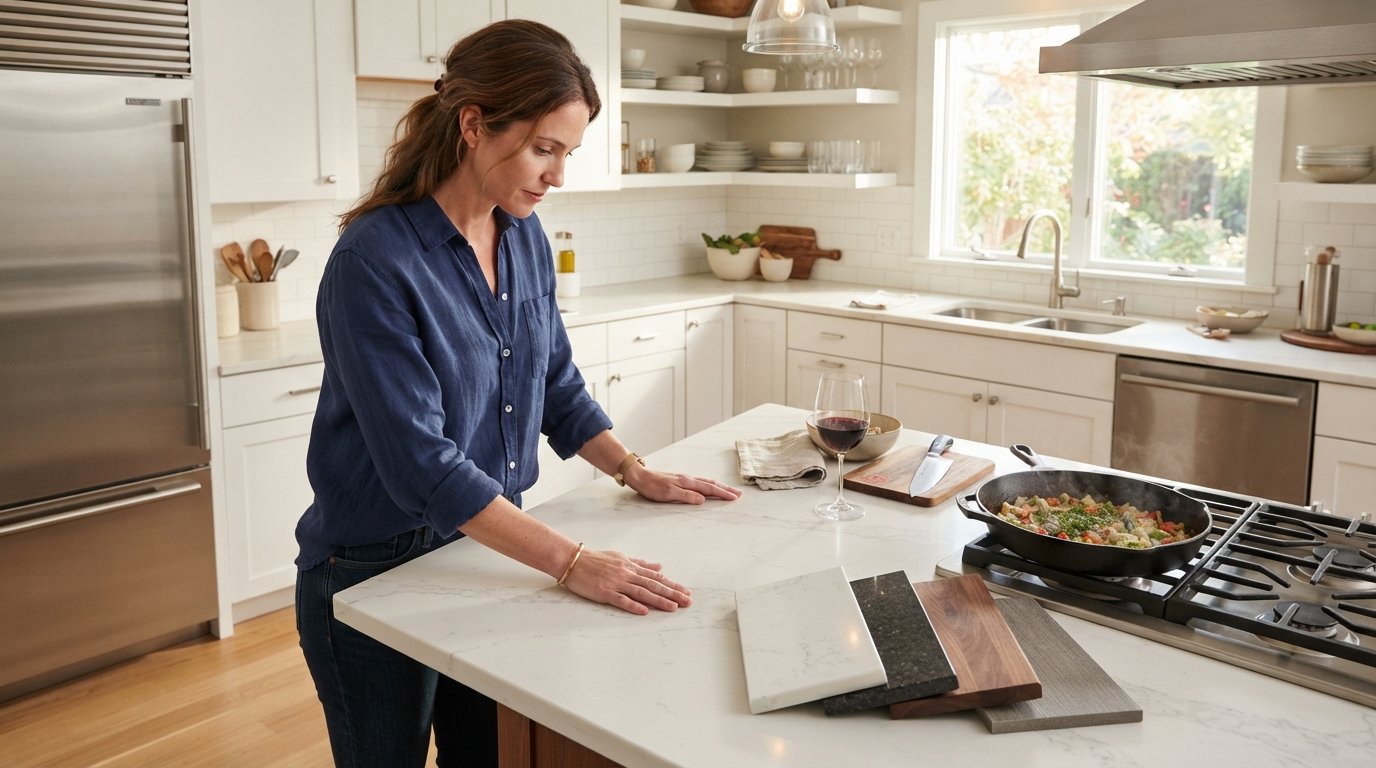
If you are still unsure, visit a showroom and touch the samples. Run a fingernail across quartz, granite, laminate, and butcher block. Put a hot mug on each. Spill a little oil and wipe it up. That hands-on test will tell you more than any spec sheet. Once you choose, you will enjoy a surface that fits your cooking, your cleaning habits, and your budget for years to come.